Tuesday, 3 January 2017

A Year of Reading

Happy New Year everyone!

Sitting in front of the tele on Boxing Day night I realised that it had been a whole year since I had watched the countdown of the top 50 children's books that inspired this blog, and my reading journey began!


On Jan 6th 2016 I embarked upon this project for real, and began subjecting you all to my reviews and ramblings! A whole year on and I've managed to read just over 10% of the list, which I think is pretty good, seeing as its been a part time reading challenge alongside my usual yearly book intake. So I'm 13 books down and there are many more exciting titles left to explore, such as Patrick Ness's A Monster Calls, This is Not my Hat by Jon Klassen and Old Possum's Book of Practical Cats by T.S Eliot. I'll admit that I have slowed down rather since the start of my MA in October, and I've not been devouring the books as quickly as I was during the summer. Carrie's War by Nina Bawden has been waiting patiently on my shelf for the last month! It's the next book on the list so I need to read it to get going again. I'll get on it soon! I am hoping that over the next few months I will rekindle my excitement for this project! I have promised myself that I will read more! I have also promised myself that I will keep a list of all the books I read this year, as I always seem to forget what I've read and when.

I've got a few more exciting things planned for Little Bookworm this year. I am hoping to expand what I write about, maybe a bit of critical theory, maybe a few interviews, maybe a bookshop tour or two, who knows. I just know that I should start exploring and experimenting with what I do here and hopefully good things will come of it! There has even been talk of starting a YouTube channel, so watch this space!

Anyway, this was just a quick post to mark the anniversary of my project I suppose. I'm planning another post, coming soon, about the books I received at Christmas, the ones I gifted, and I might even touch on the lovely adaptation of Michael Rosen's We're Going on a Bear Hunt too. And then of course there will be a post coming soon about Carrie's War!

Thanks for reading. L x

Thursday, 8 December 2016

Mental Health and The Illustrated Mum


I recently re-read Jacqueline Wilson's brilliant novel The Illustrated Mum with the view to writing my first MA assignment on it. However, things changed, other ideas came up, and i'm off on a different tack now, but I couldn't get this book out of my head. So I thought i'd share a few of my thoughts about it with you.

 If you haven't read it, and think you might want to, I'll give you a quick heads up.... this post contains SPOILERS!!!


The Illustrated Mum is a story about two sisters Star and Dolphin, and their mum Marigold. Marigold is no ordinary mum, she's creative, covered in tattoos, likes to party, and dresses like a teenage girl. There is nothing of the traditional mum about Marigold! But there's something else you need to know about Marigold, she has bipolar disorder.

Jacqueline Wilson has always tackled tough, and you might even say taboo, subjects in her literature for children; adoption, loss, broken families and mental health issues being just a few. Although she had a conventional and happy upbringing Wilson has an amazing ability to enter the heads of children in tough situations and really sympathise with their issues, worries and concerns. She tackles tricky subjects with honesty, compassion and huge emotional complexity. Her characters jump off the page at you, and are so appealing that you just can't help but fall in love with them. Wilson's books are life-lines for children suffering with the same issues as her characters, giving them encouragement and telling them it will be ok. Even if those issues are just the trials of growing up, Wilson is there for her readers. I would certainly put her up there with J.K Rowling as an author of life-saving books!

Seen through the eyes of the youngest daughter Dolphin, The Illustrated Mum charts the peaks and troughs of a parent with bipolar disorder. We see Marigold at her best and her worst, and everything in between. It is a candid look at mental health and how it effects not just the sufferer but the people around them.

A major cause of Marigold's unhappiness is her break up with Star's father Micky. She holds on to his memory, hoping that he will come back to her, but when he finally does return, he only wants his daughter, Star. The pain this causes Marigold sends her into a dark place, and it is here that this book takes on a whole new light. We are introduced to Marigold's manic episodes quite gently, with her obsessions with Micky and her tattoos, and her childlike behaviour. But as the book continues we frequently see her drinking far too much, and neglecting her children. At no point however, does Wilson imply that Marigold is a bad mother to her girls, and you never feel like you should dislike her. Marigold doubts her own abilities as a mother, but we are never explicitly told that she is a terrible mum. Dolphin is constantly reassuring her that she is good enough and that they love her very much, a reminder of the unconditional love between child and parent, despite the problems they might face. Star on the other hand, the elder of the two girls, is very aware of her mother's "bad behaviour". She has had to take on the role of "mother" instead, looking after Dolphin and Marigold as well as her school work, and she works very hard at both. Often having to make sure that she and her sister eat, she is a much more reliable mother figure than Marigold is. So when Micky appears in her life and offers her a "normal" life, away from the stresses of looking after Marigold she jumps at it! She leaves her mum and sister behind to go to Brighton to live with her Dad. She is supposed to take Dolphin with her, but ever loyal to Marigold, she refuses to go.

This is when the story changes. At the loss of both Micky and her daughter Marigold's bipolar disorder becomes markedly worse, and eventually she has a breakdown. Dolphin finds her in the middle of night, painted head to toe in white gloss paint, almost glowing in the darkness; a ghost. The passage is quite frightening, and the spectral imagery is haunting. You feel for this child, who has no choice but to deal with the horrific events unfolding in front of her. Trying to wipe out her tattoos in an attempt to become what she considers a "normal" mother, Marigold has painted herself white, and refuses to move until the paint has dried, muttering to herself and staring into space. A panicked Dolphin tries to get the paint off of her, but both the stubbornness of the paint and the stubbornness of Marigold prevent her from doing so. She has to call an ambulance and Marigold is hospitalised.

Still in primary school, Dolphin has to deal with so much, far too early. Wilson's ability to get into the head of her characters really allows you to feel what Dolphin is feeling, especially as the book is written from Dolphin's point of view. Reading this book as a child I don't remember this scene as quite so horrific. As an adult I actually found it quite disturbing, and I felt a great emotional pull towards Marigold, as well as Dolphin. I think Jacqueline Wilson deals with the issue of mental health in a sensitive and non-judgemental way. We are never seeing Marigold as just her illness, but instead as a person. We are constantly reminded that she is a woman, through the repeated motif of her tattooed body. Each chapter is named after, and features, one of Marigold's tattoos, making her body the structure of the story itself. Although the story focuses on her mental health issues, Wilson also portrays her a real person; someone with a huge personality and enormous creative flair. As an adult reader I found the character of Marigold hugely appealing, whereas I think a child reader would feel much more drawn to the girls.

We are only just breaking down the taboos concerning talking about mental health, and its 2016! Jacqueline Wilson wrote The Illustrated Mum in 1999! You could say she was ahead of her time in some respects. These days teen fiction deals with mental health issues quite freely, but in 1999 a book aimed at an even younger audience was addressing one of the biggest issues of our time, and doing it with style, sensitivity and care.

Thanks for reading, L x


Monday, 14 November 2016

No.88 - The Adventures of Captain Underpants!


Captain Underpants stands for "all things pre-shrunk and cottony!" and fights crime using y-fronts! Created by friends Harold and George, the comic book hero comes to life when they hypnotise their school Principle so he believes that he is in fact the pant-clad superhero! Dav Pilkey's wonderfully silly story The Adventures of Captain Underpants is the only book I know to claim to have both 'Wedgie Power' and 'Flip-o-Rama', and what a difference that makes! No, honestly! This is a classic book for reluctant readers! The good smattering of toilet humour is an instant attraction! This particular story includes as rubber dog poo, a evil villain in a nappy who falls foul to said poo (no pun intended), and a good amount of references to pants! It is also full of practical jokes, general mischief and downright silliness. The perfect combination!

When my boyfriend came over on Friday afternoon he found me at my desk whisking off emails to various people and having a think about my upcoming essay (more about that another day). Whilst I finished my admin he picked up the copy of The Wind in the Willows that was on my desk and proceeded to read excerpts to me, with all the voices! This was of course hilarious, so we decided to find other things he could read. We decided that The Adventures of Captain Underpants should be next! He'd read it when he was small and was keen to relive the adventure! So we snuggled up in my room and spent the whole afternoon reading. It was lovely! I faintly remember having read this book when I was small, but I wasn't sure, so I came to it with hardly any prior knowledge. It was great! I think having it read to me, complete with a myriad of American accents (!), made it all the better. I can't imagine having put that amount of animation or expression into it had I read it quietly to myself. He made it really enjoyable! 

So just for you, here is a taster of Martin reading Captain Underpants. George and Harold have just been busted by their Principle for causing havoc at a school football game, uh oh! (If you can't see the video below then you can watch it here)


I asked Martin why the Captain Underpants books appealed to him when he was small?

" I immediately found the idea of it really funny. I loved reading them because I loved the style and the humour and how the illustrations would tell their own mini stories in tandem with the text, like George and Harold changing around the letters on the school signs to make rude and silly phrases. For small books a huge amount was contained in them. The stories were hugely eventful, and each book would include an issue of George and Harold's Captain Underpants to read as part of the story (which resonated with me as a boy because I saw myself in that. I too loved writing). There was also a cool section in each book called Flip-o-rama which involved flipping a page back and fourth to animate two images which was loads of fun. I think the best part of Captain Underpants was that they were just plain funny and I remember the books were a good way of bringing me and my peers at primary school together, as we had that humour in common. "

I too remember these books being a huge hit with boys when I was growing up, and to be fair they probably still are. It has been proven that boys come to reading in a different way to girls, and that often they are slower to pick up the reading bug. The Captain Underpants books seem to be the remedy to this. My experience is that once hooked boys seem to devour the whole series, and come out of it wanting to read. I showed just the cover to my cousin Archie, who's five, and he was instantly interested, I didn't even need to read it! These, and other series that attract boys like magnets, should be treasured! We need more!

I would thoroughly recommend The Adventure of Captain Underpants to any one who fancies a laugh! It is the perfect book for reading aloud and will delight children and adults alike!

Thanks for reading, and listening! L x

Next up Carrie's War by Nina Bawden.


Thursday, 13 October 2016

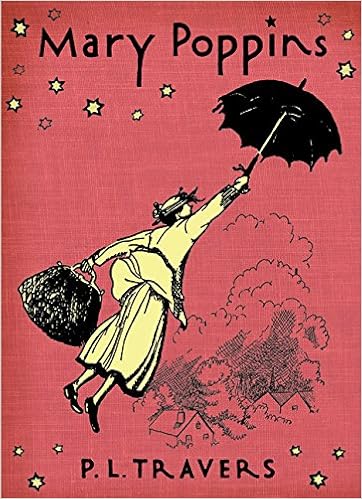
No.89 - Mary Poppins


Mary Poppins is best known as the flying nanny with the talking umbrella portrayed by Julie Andrew's in the famous Disney musical of 1964. But the real Mary Poppins was actually created 30 years before by Pamela Travers, or P.L Travers, as she was known. Travers wrote the first Mary Poppins book, which is the one that I have been reading, in 1934, but she went on to write 7 more tales of the English nanny and her magical adventure, the last of which was published in 1988.
The Disney film is based on the first four books, Mary Poppins, Mary Poppins Comes Back, Mary Poppins Opens the Door, and Mary Poppins in the Park. However, when I say based, I really mean very loosely indeed! From reading just the first book here are some differences I have spotted:

1. Bert is a peripheral character, not like Dick Van Dyke's cockney (!?) lead. 
2. Jane and Michael are not the only Banks children! There are also Barbara and John, the baby twins. 
3. Mary Poppins is not as lovely as Julie Andrews makes her out to be!
4. She is also not as posh as Julie Andrew makes her out to be!
5. The adventures in the book are so much more exciting than those in the film!

I could go on! 

Really the film and the books are non-comparable. They are so different from each other that I can see why Travers got so upset when she saw the film for the first time, and why she was so against selling the film rights in the first place. I love the musical, but I also really enjoyed the version of Mary portrayed in this book. She's a bit tougher on the children, a huge liar when it comes to admitting that she's magic and she really very very vain, but she is also wonderfully charming! I think the children both adore her, but are also quite scared of her too! 

As i've already said, the adventures in the book are far more exciting than anything that happens in the film. The laughing tea party on the ceiling is taken from the book, and they do 'Feed the birds, tuppence a bag'! The chalk painting excursion is also featured, although it is only Bert and Mary who go, and there are no race horses! But the Banks children and Mary Poppins also get up to some other great things too! When Michael gets up on the wrong side of the bed and is ghastly to everyone Mary takes them around the world in a minute. At each compass point they meet an animal from that part of the world who gives them a gift. In the original book these were people from each part of the world but this was deemed un-PC and they were changed to animals in the later editions. Mary Poppins also introduces the children to a very tiny, old lady made of butterscotch who runs a sweet shop with her two daughters. They later help Mary put paper stars back in the night sky. The children also take a night time trip to the zoo, where they find people in the cages and the animals roaming free, fully personified. The final story, which I think is lovely, is that of Maia. The children and Mary Poppins are out christmas shopping where they are met by a little girl. She is Maia, one of the seven Pleiades stars, known as the Seven Sisters. She has come down to earth to buy christmas presents for her sisters, and Mary Poppins and the children agrees to help her. Travers' original tales are truly charming, and certainly magical!

Last week I read a particularly interesting essay by Maria Tatar called A Thousand and One Tales, and in she refers to Lois Lowry's term 'Elsewhere'. Tatar explains that: 

'Elswhere is found in fairytales and fantasies - it is everything from "Once upon a time" to Wonderland, Narnia, Oz, Neverland, and Hogwarts... Elsewhere is a zone that... [gives] us what could be rather than what should be. It opens up perils and possibilities, creating an alternate world where magical thinking is validated and affirmed...' *

This got me thinking. 

If Narnia is 'Elsewhere', then the wardrobe must be the portal to 'Elsehwere', and if "Once upon a time" can transport us to these magical places, then maybe a person could too. I think Mary Poppins can be seen as a portal to Tatar and Lowry's 'Elsewhere'. Without her the children could not experience the magical events that occur in the book. She transports them to these places using her own magical powers. Magical thinking is both 'validated and affirmed'* in Mary Poppins's world. However, when they are back in reality she denies that any of the magic actually happened. Tatar suggests that 'The reality principle is soundly defeated in Elsewhere, if only to show that it is inescapable in our ordinary lives.'*. Mary Poppins' behaviour is the embodiment of this statement. By denying that anything magical ever happened, she actually makes the magic more magical and the reality even more real. Its a pity that Disney ironed out these extremes in a way. Although the magical nature of the musical is all well and good the actual stories have their mysterious sides too, which add to their appeal. 

With the current trend to remake the classic Disney films, I would love to see a film that really embraces the true nature and magic of P.L Travers books. In 2014 there was a hoax suggesting that Tim Burton was to remake the story, and frankly I would have loved to have seen that! However, I have discovered that there is new Mary Poppins film, Mary Poppins Returns, planned for release in 2018, starring Emily Blunt as our beloved nanny, so all we can do is wait, hope and watch this space! 

Thanks for reading, L x

Next up is The Adventures of Captain Underpants! A favourite of many so I have heard!


*Tatar, Maria, (2009) "A Thousand and One Tales" from Hearne, Betsy and Trites, Roberta Seelinger, A narrative compass: stories that guide women's lives, pp.39-46 (particular quotes from p. 43), Urbana, Illinois, University of Illinois Press.

Wednesday, 14 September 2016

The Lost Beatrix Potter Story: The Tale of Kitty-in-Boots

Last week marked a historic moment for all lovers of Beatrix Potter's classic animal tales. A new story was posthumously published, one that had lain forgotten for around 100 years! Beatrix Potter had written The Tale of Kitty-in-Boots in 1914, over 10 years after her first children's book The Tale of Peter Rabbit was published, but it never became more than just a manuscript. Some suggest that the advent of the First World War may have, among other things, interrupted the completion of the Kitty story, which was found with only one illustration and here it is.


It is a charming tale about a cat who enjoys poaching! Kitty or Miss Catherine St Quintin (as she likes to call herself!) likes to don a 'gentleman's Norfolk jacket and little fur-lined boots' and brandish an air-gun at every opportunity! The story follows her as she sneaks out at night to go hunting, switching places with another black cat called Winkiepeeps, so as not to arouse the suspicions of her doting owner. Here she encounters a range of wonderfully personified characters, some a little more familiar than others! She picks up her gun from her friend Cheesebox the cat, and then accidentally shoots Mrs Tiggywinkle (thankfully she only hits her bag of washing!)! She then tries to shoot mice, crows and sheep, before coming across two naughty poaching ferrets Slimmy Jimmy and John Stoat-Ferret, who are pleasingly clad in flat-caps and waistcoats. The two ferrets are after rabbits and it is here that our famous friend Peter Rabbit makes an appearance! Kitty stalks Peter for a while, but luckily doesn't shoot him because 'he was wearing such an elegant jacket' (in true Beatrix Potter style!). The story is not yet over for Kitty however, as she soon finds herself caught in a poachers trap! How ironic! Mrs Tiggywinkle saves her and we are told that she gets away 'with the loss of one toe'! Potter has often been praised for not talking down to her readers and this clearly shows it! Children's literature critic Peter Hollindale once called Potter a 'post-fabulist naturalist', suggesting she was keen to focus on the realities of the natural world, whilst also taking inspiration from the animal fable genre. She doesn't shy away from the consequences of poaching, especially when Mrs Tiggywinkle turns up (alive) in a bag full of furs, half eaten rabbits and a cat's tail! In the end Kitty gives up poaching and establishes a life as a genteel cat, having tea parties and only associating with respectable animals.

Discovered with just the one illustration, a new illustrator had to be found in order for this little gem to be unleashed on the world! What would happen to The Tale of Kitty-in-Boots without it's trademark drawings? 

Cue national treasure Sir Quentin Blake! 


I love Quentin Blake's illustrations! From Roald Dahl's stories, to his own poetry, and even his murals for hospitals, his art is full of a playfulness and joy! I recently had the opportunity to choose one of his illustrations for an exhibition at my local art gallery. You can see my choice Parrot's Toast here! 

Now, like many people, despite my love of Blake's gorgeous illustrations I was wondering how this slightly crazy, vibrant style was going to fit with the calm and genteel style of Potter's writing. I had no need to worry! Yes, they are scratchy and full of movement, and not at all like Beatrix's delicate, soft animal drawings, but this is not a negative point by any means! You just need to look at the cover to see how well he has portrayed the slightly bizarre character of Kitty! Although strikingly different to Potter's portrayal, the slightly mad glint in Kitty's eye seems to work so well with her character! She was almost too serious before!

It's so lovely to see Potter's story interpreted in a different way. The format of the book has remained in keeping with the original stories with the words and pictures on opposite pages, like windows into this secret animal world. Blake's illustrations are fitting to the story and he has interpreted the characters we know and love extremely well, so that you feel you are looking at the same character despite style differences.


All in all it is a beautiful homage to the world and writing of Beatrix Potter. 

Thanks for reading , L x

Thursday, 25 August 2016

No.90 - The Brilliant World of Tom Gates

So, I've reached number 90, meaning I have officially completed a 10th of my challenge!!! Huzzah!! 
I think my favourite book from the first 10 has got to be Inkheart by Cornelia Funke, and I urge everyone who hasn't read it to go out and find a copy ASAP! You'll enjoy it! I'd also like to say how much I loved Michael Foreman's beautifully illustrated memoir War Boy, and again I urge you all to have a look at it! 


This post's book is The Brilliant World of Tom Gates by Liz Pichon. Now, so far on this journey the books I've read haven't particularly felt like children's books. Thomas the Tank Engine has probably been the most childlike book so far, but even that felt quite grown up due to its old fashioned writing style. In a stark contrast to this Liz Pichon's book screams 'I AM FOR CHILDREN!!'. The cover itself exudes mischief, fun and childhood, to the point where it would seem that this book has actually been written and illustrated by the main protagonist Tom. And this is exactly Pichon's intention! The cover is as symbolic as the 'Keep Out' sign you might find on a teenagers door or diary, and as an adult reader I almost felt like I was prying! Tom, whom I would place at about 10 years old, is the heart and soul of this book and to all intents and purposes the book is written by him. When you open this book it's not your traditional print book, but instead it is more of a journal or notebook in which 'Tom' has doodled and recorded his life. Just take a look! 


Pichon absolutely succeeds in making you believe that this is the genuine article rather than a work of fiction, and I can imagine that this is very appealing for a pre-teen reader! I think some children, and in particular boys, as many studies have proven, struggle with a traditional print book. This is not to say that their reading skills are below average, but I just think that for some children the idea of a block of text can be quite daunting. What Pichon has achieved here, and in the rest of the Tom Gates series, is a book that is totally accessible. It's numerous amusing doodles, annecdotes and stream of conciousness style of writing keeps the readers attention in a way that a print book just can't. Children can't get bored of Tom Gates's world because the story changes and develops at such a fast pace! For an adult reader this was hard to keep up with and I struggled a little trying to put myself in the place of a 10 year old boy who liked nothing more than annoying his older sister and was obsessed with a rock band called Dude 3!! However, for many 10 year olds this will no doubt strike a chord, and I'll admit that some of Tom's world seemed familiar even to me! (In particular the trial of bumping into a teacher outside of school! Who doesn't remember how weird that was!? And Tom's teacher was wearing leather trousers!! Awkward!) 

I take my hat off to Liz Pichon for creating a book that so wonderfully (and amusingly, may I add) gets into the headspace and world of Tom. She makes it seems so effortless, and this is the beauty of this book. I would certainly recommend it to anyone who is struggling to get a child into reading, in particular boys. It's a quick read, full of wit, mischief and in some ways the reality of school life when you're 10! The embarrassment of parents, the importance of seeing your favourite band, and the horror of school photos and parents evening! The doodles make it endearingly fun and there is even an interactive element, with a lesson on how to draw Tom's older sister Delia at the back! 

Although I was extremely conscious that this book was aimed at a child audience and felt like I was in forbidden territory, for the intended readership I think The Brilliant World of Tom Gates is a very original, enjoyable book that shouldn't be missed! 

Thanks for reading! L X

In other news I'm going to be taking a little break from the blog in September while I make preparations and get started on my MA in Children's Literature! It's all very exciting, but there is so much reading to do that I am going to have to focus on that for a bit. I'm hoping though that what I learn will inform my reading of the books on this list, and in turn produce more interesting posts for you to read, so it's a win win situation! Don't worry though, it won't be long before I'm back here telling you all about the course and the next book on the list, Mary Poppins by P.L. Travers! L x

Monday, 15 August 2016

No. 91 - Saffy's Angel


In the last week or so i've had so many ideas for this blog that I think my head might explode!! I've made lists of things that i'd like to try out, so hopefully there'll be a lot more than just book reviews happening in this space soon! If you read my last post about books vs films then you'll have got a little flavour of things to come, including more engagement with children, and topics other than the books that i'm reading. I'm really hoping to expand what Little Bookworm is about! 

Anyway, today is another review. This time its number 92 on my list, Saffy's Angel by Hilary McKay.


The title seemed familiar and when I read the synopsis I realised that i'd read this book when I was younger, so I was quite interested to see how I would feel coming back to it as an adult. The story is about Saffy, a 13 year old girl who goes to Italy in search of a stone angel left to her in her Grandfather's will. I can't remember my exact opinion of this book from when I was small, but i'm afraid to say that as an adult reader I found the story a little thin, which is a shame. However, what I absolutely love about this story is Hilary McKay's characterisation!

The story centres around the Casson family, a loveable, but truly chaotic family of six. Bill and Eve Casson are artists, and their three children, Cadmium (Caddy), Indigo and Rose are all named after paint colours, which is a really lovely touch. Saffron (Saffy) is adopted, she is the daughter of Eve's sister, who died in a car accident whilst living in Italy. Her name does not appear on the paint chart in their kitchen, and this was how she discovered that Bill and Eve were not really her parents. McKay deals with the concept of adoption in a gentle and sensitive way by placing great emphasis on the closeness of the Casson family children, including Saffy. She refers them as a pack. They all stick up for each other, each offering their own individual strength to family life, and this is how they muddle along together.

Each character has their own individual quirky nature, making them wonderfully endearing, and this is what I love about this book! Caddy, the eldest, is scatty, away with the fairies a lot of time, and breeds Guinea Pigs in the front garden! She dreams of studying Zoology at university and going to work in Africa, just as soon as she manages to pass her A Levels. Then there is Indigo, the only boy of the pack, he has dreams of becoming an Arctic explorer once he's faced his fears and feels brave enough to leave his sisters. He spends a lot of time sitting on the outside edge of his window sill confronting his fear of heights! The smallest Casson child is Rose, known to her siblings as Permanent Rose, because she was very poorly as a baby but now she's not going anywhere (coincidently, it's also a paint colour). She loves art, and is always painting something, somewhere in the house; she also eats paint which her mum believes made her a stronger baby! Mum Eve, spends all her time painting in her shed and unfortunately sometimes forgets she has children to look after, hence the need for the Casson kids to stick together. Their long-suffering dad Bill spends most his time in his London studio, escaping the chaos that is his family! And finally there is Saffy, not a true Casson, but loved by them all the same. She is much calmer than the others and has a bit more of a grasp on reality. As you can see McKay has excelled in creating characters that really grasp the readers attention. By giving so much background and character information within the story readers can identify with the characters in the best way possible; as if they were their family or friends, or even themselves. Even I found myself wishing that I had a sister like Caddy, and thinking wouldn't it be nice to live in a house like theirs. However, realistically I don't think my nerves could take it!! I'm more like Bill Casson than i'd care to admit!

Despite being a fairly ordinary story of a teenager on a journey of personal discovery, McKay manages to create a whole extraordinary domestic world in which it can happen. From the house itself, to what's for dinner, the Casson's slightly dysfunctional home life is a joy! I am pleased to say that there are three more books in the Casson family series, and despite not loving this story, I feel compelled to read the next books to find out what happens to these wonderful characters as they grow up! The Casson family is not a family you can forget about quickly!

Thanks for reading! L x

Next up is The Brilliant World of Tom Gates by Liz Pichon.