Showing posts with label children. Show all posts

Friday, 12 August 2022

No.56 - The Silver Sword

To my absolute disgust I had this book out from the library for the 18 months... I got it out right before the first UK lockdown, and had it for months after! And, do you know whats made me even more ashamed... It took me all that time to read it, and at least another year to post this!! So finally, here is my experience of Ian Serraillier's classic Second World War novel The Silver Sword


This is one of those children's books that hits you hard. It tells the story of the Balicki children, growing up in war torn Europe during WW2 and the Nazi regime, and their journey to be reunited with their parents. It often amazes me that childen's books can deal with these topics in such a careful, emotive way, without being overtly scary or disturbing. The authors manage to distill the topics, sites and sounds so that we feel all the emotions and tension without the adult themes. This is particuarly powerful when dealing with troubling themes for middle-grade readers. Ian Serraillier does this beautifully in The Silver Sword. 

Ruth, Edek and Bronia Balicki are left in war torn Poland after their father Joseph is arrested for his anti-nazi sentiments. After escaping prison he makes his way back to Warsaw only to find that his home and the neighbourhood he lived in has been bombed and his children are missing. Whilst looking in the rubble of his home he discovers a sword shaped letter opener that his wife had bought for him, but along with this discovery he also finds Jan, an orphaned boy, and his pet chicken, intent on stealing the shiny letter opener. Joseph agrees to let Jan keep it on one condition, if he ever sees the Balicki children he should tell them that if they make their way to their grandparents house in Switzerland he will meet them there and they will all be safe. 

I won't give away much more of the plot, because my description would not do the story justice at all. This story has twists and turns, well rounded characters and a sense of hope that can only be experienced by reading the book. And I'm not at all surprised, as this book is based on true events. Some place names have been changed, along with names of the camps that appear in the story, but overall the main plot of this book is based on true accounts of life in Nazi occupied Europe during World War Two. Without books like this it would be hard for modern children to understand exactly what their conterparts at this time went through. Children need to read about children, to relate to the characters that mirror their own ages' life experiences. This is why school stories are forever enduring. It is also why books like Carrie's War and Goodnight Mr Tom are used to educate children about the Second World War, and Ian Serraillier's book is no exception. Although children can't relate to the hardship of the Balicki children, they can relate the fact that they are children, and this is key. This book is another one of those enduring stories that will continue to be used in schools and recommened to children, because it is so authentic. Although it took me a while to get through it, I would read The Silver Sword again, and no doubt I would pick up on different details the second time around, which is great. It is a heartwarming, but also heart rending tale, and I really enjoyed it. Yes, Jan is stubborn and annoying, and yes, the girls are a little stereotypical, but that being said, the children are strong characters and you end up really warming to them and routing for them to get to their parents! But I wont spoil the ending for you! 

Thanks for reading, L x


Sunday, 15 March 2020

No. 68 - The Family from One End Street (and World Book Day 2020)

It's World Book Day month, hooray! Thursday 5th March was World Book Day, a favourite of mine as you may already know. I love seeing which characters children dress up as, and how their little imaginations are sparked by literature of all kinds. The free books for this year's World Book Day are fantastic as always, with authors such as Anthony Horowitz, Robin Stevens, and Matt Haig contributing brand new stories. You can see the full list of the books here, so encourage children to cash in those vouchers and grab a new short story!


As for today's post, I want to talk to you about Eve Garnett's masterpiece The Family from One End Street. First published in 1937, this book oozes authenticity in a way books these day's rarely do. It is a wonderful depiction of the life of the Ruggle family, who live at No.1 One End Street, in the fictional town of Otwell-on-the-Ouse (which is said to be based on Lewes in Sussex). Nothing extraordinary happens, and the setting is thoroughly domestic, but this is it's appeal. It is wonderfully mundane.

Unusually for the time, it focuses on the life of a working class family. The mum, Rosie Ruggle does people's laundry and Dad, Jo Ruggle is a dustman. They have seven children, Lily-Rose, Kate, Jo, twins John and James, Peggy and baby William. Children of the time were more likely to be reading about the exploits of middle-class families, think about The Famous Five and The Secret Seven, so this book was quite special. Just like the typical middle-class adventure novel, most of the chapters are based around the children, following their exploits and adventures (although I use the term loosely). The Ruggle's tales are moral, entertaining, and often follow the troubles of their everyday life. What happens when Lily Rose melts a rich ladies petticoat with an iron, and how will the Ruggle's afford Kate's new school clothes? Will they make it to London to see Uncle Charlie in the parade? There are so many lovely episodes in this book that will have you routing for the working class Ruggle's. It is so endearing, plus there is a lovely air of gentle humour about these stories which I really enjoyed.

These days children expect stories with exciting twists and turns, fast action, and snappy storylines to keep them reading. There doesn't seem to be as many books that are slower paced, and actually deal with the domestic level of life quite like this does. I worry that the publishing industry has it's work cut out trying to create books for the screen generation, who expect everything to be instant and quick. Books like Eve Garnett's require consideration and time. Although it is by no means a difficult read, it requires absorption. There are no quick fixes here. The stories are charming, and although not much happens, you enjoy going on a small scale adventure with these characters. It puts me in mind of Shirley Hughes books, in particular the 'My Naughty Little Sister' series, which I adored as a child. This slow, gentle pace of story telling is a rare beast these days I think, and that is a huge pity. I understand that nowadays children would find it hard to identify with a child from the 1930s, and as an adult reader I have a greater understanding of this time period. However, I feel it's such a shame that it is no longer a favourable way of storytelling. The stories in this book are refreshing. There are no arguments, no social media fallout, no political or environmental worries, no gender politics, these stories are simple, wholesome and uplifting. 

Like the stories themselves, the illustrations have a similar feel. I think this is because they were also created by Garnett. They are simple line drawings, yet packed with tons of expression and life. You feel like you've taken a look into her sketchbook after a day out. Just look at the one below showing the family at the beach one Bank Holiday.


I would thoroughly recommend this book to anyone who loves a bit of nostalgia! It's stories and characters hark back to a time when life was simpler. There is more of a clear gender and class divide, yes, but then this book was written at a time when that was normal. I wouldn't however say the characters fall into those stereotypes. Those girls are quite feisty, and the boys have their moments of weakness. Even Mr Ruggle has moral dilemmas to face. Overall this book is a lovely example of domestic fiction for children at it's best. It is about the love, and life, of a family.

Thanks for reading, L x

Next up, it's the Asterix comics by Uderzo and Goscinny!

Friday, 28 July 2017

No. 80 - Old Possum's Book of Practical Cats

This post marks a huge milestone in my book reading journey! Old Possum's Book of Practical Cats by T.S Eliot is number 80 on the list, which means that I am 20% of the way through my challenge! Hurrah! I'm really enjoying reading all the books, whether I've read them before or not. Coming up are some books that I fondly remember, and some that I've never even heard of, so that should be fun! I've also got a few other things up my sleeve too, so watch this space! 


T.S Eliot was one of the most famous poets, critics and playwrights of the twentieth century. Despite having written some of the most infleuntial poetry and prose works of that time, surprisingly his best selling book has been Old Possum's Book of Practical Cats! This intriguing work about the nature of cats started its life as a selection of poems created to entertain the children of Eliot's close friends. It was later published as a book by Faber, in 1939. I love the cover of the Faber edition above, being quite the fan of an Axel Scheffler drawing! 

These days I would say we are most familiar with the poems as being the lyrics used in Andrew Lloyd Webber's musical Cats, which was a very successful stage show indeed. So it was tricky to read the poems without putting them to the tunes that I knew! Especially Macavity! It helped to listen to T.S Eliot reading the poems himself, which you can do here! It's definitely worth a listen. 

In the 14 poems in this collection we meet an array of characters; Mr Mistoffelees the Original Conjuring Cat, Gus the Theatre Cat, Skimbleshanks the Railway Cat, Mungojerrie and Rumpleteaser, Jennyanydots, Rum Tum Tugger, the Jellicles Cats, Old Deuteronomy, the Pekes, the Pollicles, The Great Rumpuscat, Macavity the Mystery Cat, and Bustopher Jones the Cat About Town. By far the best thing about these poems is the amazing names Eliot has given to all the cats, and the way he talks about those names. In the first poem 'The Naming of Cats', he explains that cats have three names, an everyday name such as Peter, James or George (fair enough), then a name that's a little more extravagant than that, for example, Munkustrap or Bombularina (woah!!), and finally a name that only they know, and we will never find out! To my great pleasure, I have just read that Eliot was most certainly a 'cat person' and some of his cats had equally as marvellous and peculiar names! Eliot had cats called Pettipaws, Jellylorum, George Pushdragon, and Wiscus!*

This collection of poems was a little formal in language and tone due to its age, but other than that it was a great read. Each poem is a little cameo of the eccentric feline characters Eliot has dreamt up. My favourite by far is Gus the Theatre cat, who you can just imagine recounting his tales of the stage to a captive audience in a pub! I also love that Gus is short for Asparagus, another fabulous cat name! I would thoroughly recommend that there be a copy of Old Possum's Book of Practical Cats on every bookshelf! One like the Faber edition above would be perfect for older children (and adults of course!), and for younger ones I would recommend getting one or two of Arthur Robins's picture book versions, which focus on just one poem per book. So go forth and buy! 

Whilst I'm here talking to you all about poetry, I'd quickly like to say a few words about the importance of poetry for children. There have always been poetry anthologies for children, and fabulous children's poets out there, but for some reason prose has always had the upper hand. Poetry books are valid 'reading books' for children just as any other texts are, and I think sometimes we forget this. I was recently volunteering in my local library helping with the Summer Reading Challenge (anyone with children should get them down to the library and to sign them up asap, but more about that another time!). Whilst showing a little girl around the children's department she asked me if there were any poetry books? I'm ashamed to say that it almost took me by surprise, but then I realised that that was as valid as any of the other books I was showing her, and good on her for wanting to explore something more than a prose story. Aside from listening to poetry as a child, my main experience of it was when I got secondary school. Suddenly we were analysing metre, language and imagery, picking poems apart to see what they were made of. It became a chore, albeit one I actually quite enjoyed, but still associated with the stress of exams and grades. So, I suppose what I'm trying to say is that children should be encouraged to explore poetry for the fun of it, far before they reach the age where it becomes just another thing they need to master in order to jump through academic hoops. They need to be able to enjoy a poem just because of the way it sounds, and bask in the images that it conjures up in their imaginations, without having to analyse all the why's and how's. The Book Trust have a lovely list of their favourite poetry books for children here, which I recommend having a look through if you're interested. There's some great books on it, including Arthur Robins's version of Mr Mistoffelees, and Julia Donaldson's Crazy Mayonnaisy Mum, which is the poetry book that my little library visitor chose to take home. 

Thanks for reading, L x

Next time, it's The Little Prince by Antoine de Saint-Exupery. 


* This and some of the other information in this post came from a wonderful article by John Sutherland on the British Library website, which you can find here. It talks about the background and context of Old Possum's Book of Practical Cats and is well worth a read. Arthur Robins's

Thursday, 5 January 2017

Children's lit is for life not just for Christmas!

The festive season has been and gone. We're all wondering why there's still Quality Street knocking about, and whether enough time has passed to warrant buying more cheese, and for it not to count as a cheeseboard anymore...? I've just about got my head around what day of the week it is again! Thursday right? Anyway, with all the confusion comes the calm and quiet, which allows you to look back over your presents and truly appreciate what you were given by the ones you love, and what fun you had gifting things to them too. I thought I'd share with you the two beautiful children's books I was given for Christmas, and the three I chose to give to the little people in my life, and what I thought of We're Going on a Bear Hunt.

First up, Harry Potter and the Chamber of Secrets, illustrated by the incredibly talented Jim Kay! 


This book is beyond beautiful! I was keenly anticipating receiving this book for Christmas, hoping that my other half would continue the tradition he set last year when he bought me the first one, and he didn't disappoint! Hooray, and thank you Martin! I came to Harry Potter late but have since found myself totally enchanted by the Wizarding World, and Jim Kay really brings it to life in these books! The Chamber of Secrets is packed with stunning illustrations, bold double page spreads, little intriguing details and fabulous mark making. Magic oozes from it's pages, it's truly spectacular! This book is a real treasure, as is the first one, and I can't wait to see what the next one will look like!


Secondly, a touching picture book about love, loyalty, pride and a piano playing bear. 


I came across David Litchfield's debut picture book The Bear and the Piano on one of my many visits to my local Waterstones's children's section not that long ago, though it was released in 2015. We stood and poured over the enchanting illustrations, and were really touched by the story, reading it aloud like we do with every story we come across (Someone should really employ us!)! So when I unwrapped this book at Christmas I was over the moon! Again, thank you Martin! Here's a little about it.

A bear cub discovers a piano in the forest, and with it a passion for music. Returning to the piano everyday he teaches himself to play, persistently playing until the sounds he makes are beautiful. He gives performances for his fellow bears, until one day some humans suggest he could be a successful concert pianist in the city and so he goes with them. The bear becomes a huge star, packing concert halls every night, but he misses his home. Returning to the forest years later he believes that his family and friends have forgotten him, but in fact they have been keeping up with his progress and have created a shrine to him around his beloved piano, full of his CDs, newspaper cuttings and programs. This book is so tenderly written that I can't help but feel a bit teary when the bear finds his friends have not forgotten him. It's quite moving! In a good way! I urge you all, young and old, to get hold of a copy of this gorgeous book, as it definitely contains a message for all of us.


Now, from one bear to another. I wanted to quickly talk to you about the Channel 4 adaptation of We're Going on a Bear Hunt by Michael Rosen that hit our screens on Christmas Eve. I watched it on Christmas day with my mum and my boyfriend, and while they were happily enjoying the story of a children on an adventure I was a sobbing wreck! It broke me! And here's why!
The whole thing was beautifully done, using hand drawn animation that stayed true to Helen Oxenbury's delightful illustrations in the book. However, what got me was the new additions to the story. The children had clearly lost their Grandpa fairly recently according to this new version, and it was full of sentimental moments where the children remembered him whilst they were walking, and the addition of a recently widowed Granny upped the emotion considerably!  When Rosie broke away from the others in the cave and discovered the bear, made friends with him, and gave him Grandpa's scarf to keep him warm I was holding my tears back! My lip wobbled as the other children dragged the little girl away from the bear and back home. It upset me even more when, as in the book, the children locked the bear out and hid upstairs! By the time the Rosie was telling Granny that she missed Grandpa during the Christmas festivities I was a mess! The end credits rolled and I burst into uncontrollable tears! "The bear is Grandpa", I sobbed, "and the others haven't noticed!" Whether it was the exhaustion of Christmas, or whether this adaptation really had pushed all my emotional buttons it was hard to tell! I thought about it more later on and another thing struck me. Maybe the Bear wasn't Grandpa at all, but a representation of grief. The children ran away from it because they didn't want to face the loss they felt, all accept Rosie who was openly grieving for her lost grandparent. Now, I can hear you all saying "It's just a story Lottie, I can't be that deep!" But one thing my MA has taught me is that there are often a lot more layers to things than you think! But, yes, I probably read to much into it, and besides, that's not how Michael Rosen's story goes anyway! That's just a joyous exploration by children of their terrain and imaginations, without the sentimentality we all have to suffer just because it's Christmas! All in all I was impressed with the adaptation of this classic picture book, and theres a really lovely video about how it was made that you can watch here if you're interested. I just could have done without the emotional breakdown, thats all!!!


I'd also like to share with you the children's books that I gifted this Christmas too. First up Mr Creep the Crook written by Allan Ahlberg and illustrated by Andre Amstutz.


Archie, who is 5, loves Janet and Allan Ahlberg's classic picture book Burglar Bill (a fav of mine, as you all probably know by now!!). So keeping with the spirit of 'cops and robbers' I bought him this book for Christmas. Part of Allan Ahlberg's Happy Families series, a collection of 20 books all with titles like the characters from the Happy Families card game, this book is truly charming! Mr Creep is a bit naughty, much like our friend Burglar Bill! Unlike Bill though, he's been caught! When he escapes from prison he decides to take his whole family, including their rather naughty dog, to the seaside. There he learns that being bad is not all its cracked up to be. Seeing as Archie liked the humour, the story and characters of Burglar Bill I thought this book might a hit, and I really hope it is! Also he's at the age where he's learning to read and the simple text and image layout seemed to me to be a nice beginners read, and if not his sister can always read it to him!


For her, I bought Claude on the Slopes by Alex. T. Smith.


Last year I bought her Claude in the Spotlight and she loved it! So knowing she was a fan of the debonair dog and his sock sidekick I chose her another. I love the Claude books, mainly for their humour, but also for their brilliant illustrations and retro feel. Claude is pretty cute and certainly endearing, and Sir Bobblysock is about as perfect as a slightly camp, anthropomorphised sock can get! The humour is both adult and child friendly, which I think is quite important in a children's book. In this particular book Claude and Sir Bobblysock go skiing, cause an avalanche and have to become mountain rescue!! It's brilliant! I would suggest that these books are a must read for any child between the ages of about 5 and 8, or any age to be honest! You'll love them!


 And lastly, a book for a baby.


When I set out to buy a book for my friends baby boy for his first christmas I had so many ideas! I wanted to get him a real classic, a beautiful book that he'd treasure, and then I remembered, 1- he's only very small, and 2- he might have a lot of the go-to classics already, and I didn't want to double up. I came across Peekaboo Zoo by Kate Merritt quite unexpectedly and I instantly fell in love with it's bright, bold baby friendly illustrations and fun flaps to lift (I love a 'lift the flap' book!). But the clincher for me was the little mirror on the last page, which lets the baby see their own reflection after saying peekaboo to all the animals throughout the book. This was a lovely touch, and also a nice interesting visual element for James too after the static illustrations. Reflections are fascinating things after all!


Ok, so there you go, a round up of the children's book I gave, received and enjoyed over Christmas.
I hope you liked it!

Thanks for reading! L x

Thursday, 13 October 2016

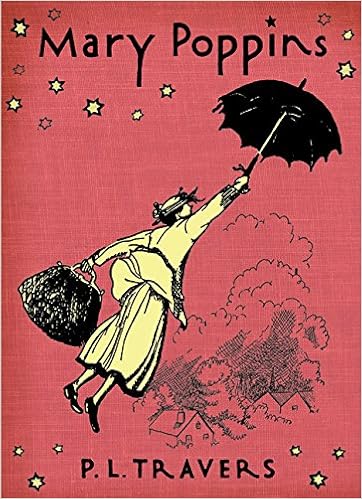
No.89 - Mary Poppins


Mary Poppins is best known as the flying nanny with the talking umbrella portrayed by Julie Andrew's in the famous Disney musical of 1964. But the real Mary Poppins was actually created 30 years before by Pamela Travers, or P.L Travers, as she was known. Travers wrote the first Mary Poppins book, which is the one that I have been reading, in 1934, but she went on to write 7 more tales of the English nanny and her magical adventure, the last of which was published in 1988.
The Disney film is based on the first four books, Mary Poppins, Mary Poppins Comes Back, Mary Poppins Opens the Door, and Mary Poppins in the Park. However, when I say based, I really mean very loosely indeed! From reading just the first book here are some differences I have spotted:

1. Bert is a peripheral character, not like Dick Van Dyke's cockney (!?) lead. 
2. Jane and Michael are not the only Banks children! There are also Barbara and John, the baby twins. 
3. Mary Poppins is not as lovely as Julie Andrews makes her out to be!
4. She is also not as posh as Julie Andrew makes her out to be!
5. The adventures in the book are so much more exciting than those in the film!

I could go on! 

Really the film and the books are non-comparable. They are so different from each other that I can see why Travers got so upset when she saw the film for the first time, and why she was so against selling the film rights in the first place. I love the musical, but I also really enjoyed the version of Mary portrayed in this book. She's a bit tougher on the children, a huge liar when it comes to admitting that she's magic and she really very very vain, but she is also wonderfully charming! I think the children both adore her, but are also quite scared of her too! 

As i've already said, the adventures in the book are far more exciting than anything that happens in the film. The laughing tea party on the ceiling is taken from the book, and they do 'Feed the birds, tuppence a bag'! The chalk painting excursion is also featured, although it is only Bert and Mary who go, and there are no race horses! But the Banks children and Mary Poppins also get up to some other great things too! When Michael gets up on the wrong side of the bed and is ghastly to everyone Mary takes them around the world in a minute. At each compass point they meet an animal from that part of the world who gives them a gift. In the original book these were people from each part of the world but this was deemed un-PC and they were changed to animals in the later editions. Mary Poppins also introduces the children to a very tiny, old lady made of butterscotch who runs a sweet shop with her two daughters. They later help Mary put paper stars back in the night sky. The children also take a night time trip to the zoo, where they find people in the cages and the animals roaming free, fully personified. The final story, which I think is lovely, is that of Maia. The children and Mary Poppins are out christmas shopping where they are met by a little girl. She is Maia, one of the seven Pleiades stars, known as the Seven Sisters. She has come down to earth to buy christmas presents for her sisters, and Mary Poppins and the children agrees to help her. Travers' original tales are truly charming, and certainly magical!

Last week I read a particularly interesting essay by Maria Tatar called A Thousand and One Tales, and in she refers to Lois Lowry's term 'Elsewhere'. Tatar explains that: 

'Elswhere is found in fairytales and fantasies - it is everything from "Once upon a time" to Wonderland, Narnia, Oz, Neverland, and Hogwarts... Elsewhere is a zone that... [gives] us what could be rather than what should be. It opens up perils and possibilities, creating an alternate world where magical thinking is validated and affirmed...' *

This got me thinking. 

If Narnia is 'Elsewhere', then the wardrobe must be the portal to 'Elsehwere', and if "Once upon a time" can transport us to these magical places, then maybe a person could too. I think Mary Poppins can be seen as a portal to Tatar and Lowry's 'Elsewhere'. Without her the children could not experience the magical events that occur in the book. She transports them to these places using her own magical powers. Magical thinking is both 'validated and affirmed'* in Mary Poppins's world. However, when they are back in reality she denies that any of the magic actually happened. Tatar suggests that 'The reality principle is soundly defeated in Elsewhere, if only to show that it is inescapable in our ordinary lives.'*. Mary Poppins' behaviour is the embodiment of this statement. By denying that anything magical ever happened, she actually makes the magic more magical and the reality even more real. Its a pity that Disney ironed out these extremes in a way. Although the magical nature of the musical is all well and good the actual stories have their mysterious sides too, which add to their appeal. 

With the current trend to remake the classic Disney films, I would love to see a film that really embraces the true nature and magic of P.L Travers books. In 2014 there was a hoax suggesting that Tim Burton was to remake the story, and frankly I would have loved to have seen that! However, I have discovered that there is new Mary Poppins film, Mary Poppins Returns, planned for release in 2018, starring Emily Blunt as our beloved nanny, so all we can do is wait, hope and watch this space! 

Thanks for reading, L x

Next up is The Adventures of Captain Underpants! A favourite of many so I have heard!


*Tatar, Maria, (2009) "A Thousand and One Tales" from Hearne, Betsy and Trites, Roberta Seelinger, A narrative compass: stories that guide women's lives, pp.39-46 (particular quotes from p. 43), Urbana, Illinois, University of Illinois Press.

Wednesday, 14 September 2016

The Lost Beatrix Potter Story: The Tale of Kitty-in-Boots

Last week marked a historic moment for all lovers of Beatrix Potter's classic animal tales. A new story was posthumously published, one that had lain forgotten for around 100 years! Beatrix Potter had written The Tale of Kitty-in-Boots in 1914, over 10 years after her first children's book The Tale of Peter Rabbit was published, but it never became more than just a manuscript. Some suggest that the advent of the First World War may have, among other things, interrupted the completion of the Kitty story, which was found with only one illustration and here it is.


It is a charming tale about a cat who enjoys poaching! Kitty or Miss Catherine St Quintin (as she likes to call herself!) likes to don a 'gentleman's Norfolk jacket and little fur-lined boots' and brandish an air-gun at every opportunity! The story follows her as she sneaks out at night to go hunting, switching places with another black cat called Winkiepeeps, so as not to arouse the suspicions of her doting owner. Here she encounters a range of wonderfully personified characters, some a little more familiar than others! She picks up her gun from her friend Cheesebox the cat, and then accidentally shoots Mrs Tiggywinkle (thankfully she only hits her bag of washing!)! She then tries to shoot mice, crows and sheep, before coming across two naughty poaching ferrets Slimmy Jimmy and John Stoat-Ferret, who are pleasingly clad in flat-caps and waistcoats. The two ferrets are after rabbits and it is here that our famous friend Peter Rabbit makes an appearance! Kitty stalks Peter for a while, but luckily doesn't shoot him because 'he was wearing such an elegant jacket' (in true Beatrix Potter style!). The story is not yet over for Kitty however, as she soon finds herself caught in a poachers trap! How ironic! Mrs Tiggywinkle saves her and we are told that she gets away 'with the loss of one toe'! Potter has often been praised for not talking down to her readers and this clearly shows it! Children's literature critic Peter Hollindale once called Potter a 'post-fabulist naturalist', suggesting she was keen to focus on the realities of the natural world, whilst also taking inspiration from the animal fable genre. She doesn't shy away from the consequences of poaching, especially when Mrs Tiggywinkle turns up (alive) in a bag full of furs, half eaten rabbits and a cat's tail! In the end Kitty gives up poaching and establishes a life as a genteel cat, having tea parties and only associating with respectable animals.

Discovered with just the one illustration, a new illustrator had to be found in order for this little gem to be unleashed on the world! What would happen to The Tale of Kitty-in-Boots without it's trademark drawings? 

Cue national treasure Sir Quentin Blake! 


I love Quentin Blake's illustrations! From Roald Dahl's stories, to his own poetry, and even his murals for hospitals, his art is full of a playfulness and joy! I recently had the opportunity to choose one of his illustrations for an exhibition at my local art gallery. You can see my choice Parrot's Toast here

Now, like many people, despite my love of Blake's gorgeous illustrations I was wondering how this slightly crazy, vibrant style was going to fit with the calm and genteel style of Potter's writing. I had no need to worry! Yes, they are scratchy and full of movement, and not at all like Beatrix's delicate, soft animal drawings, but this is not a negative point by any means! You just need to look at the cover to see how well he has portrayed the slightly bizarre character of Kitty! Although strikingly different to Potter's portrayal, the slightly mad glint in Kitty's eye seems to work so well with her character! She was almost too serious before!

It's so lovely to see Potter's story interpreted in a different way. The format of the book has remained in keeping with the original stories with the words and pictures on opposite pages, like windows into this secret animal world. Blake's illustrations are fitting to the story and he has interpreted the characters we know and love extremely well, so that you feel you are looking at the same character despite style differences.


All in all it is a beautiful homage to the world and writing of Beatrix Potter. 

Thanks for reading , L x

Wednesday, 6 July 2016

No.94 - A Wizard of Earthsea


I'll be the first person to admit that fantasy is not really my bag. I've read a bit of Terry Prachett and Neil Gaiman, and of course Harry Potter, but i've never tackled the likes of Tolkein for example! So when I was confronted with A Wizard of Earthsea I was interested to see how i'd enjoy it. Unfortunately, it was not for me! 

I don't want to be super critical of this book, but there were certain aspects that I struggled with. Originally published in 1968, A Wizard of Earthsea is a coming of age story about a young wizard searching to find his true self (sound familiar!?). Before reading this book I'd read that A Wizard of Earthsea could be considered a forerunner to boarding school/fantasy stories such as The Worst Witch by Jill Murphy and the Harry Potter series. This filled me with hope, as I really enjoyed both of these! However, the boarding school part of this story was extremely brief, and quite early on in the story. The entire plot was what I would term 'flitting', jumping from one thing to the next, leaving the reader feeling a tad confused. I felt there were many moments where I was left wanting just a little more story, or information. As a younger reader I feel I would have really struggled to keep up with the narrative, especially as the location was constantly changing, along with the array of characters and even their names. 

Names play a huge role in this story, as the hold the key to the true version of things, ie. characters and animals have their given names and their true names. Just explaining this to you has confused me, and gives you an idea of how complex this story is. By the end of Chapter One, Duny, the main character, is given his 'true name', and is referred to as Ged for the rest of the book. I know it sounds silly but it took me a while to understand what had happened and who Ged was, so I can imagine that for a child this would cause some confusion! 

The language and narrative style were also quite complex, and I found it much easier to read it out loud than in my head! I'd like to take this moment to apologise to anyone who had this book read at them over the last few weeks! Set around an archipeligo of islands there were lots of really odd place names such as Vemish, Iffish and Gont. Le Guin refers to all these places like you've been there, know exactly where they are and who lives there, which makes it even more confusing! There are sections where she explains locations and their mythology, which in some ways was helpful, but the way it was written was quite dense. However, she also provides some rather helpful maps, which made it much easier to chart Ged's journey! 


Our hero sets loose a dark shadowy beast/creature/thing which continues to follow him around the archipelago trying to kill him... I think! Every time he faces this thing it weakens his powers. The book is mainly made up of him sailing around, trying to run away from it! However, after consulting his mentor Ogion the Silent (a fine example of one of the names in this book, but not as good as Kurremkarmerruk the Master Namer, which i'm still not sure how to pronounce!!) he decides to go after the beast, and the book culminates in their face off. I shan't tell you anymore in case you fancy trying it out for yourself! Personally, it was quite a slog for me, but if you're used to fantasy fiction then you might really enjoy it!

Thanks for reading X

Next up, the children's classic Thomas the Tank Engine by Rev. W. Awdry

Wednesday, 11 May 2016

So what is good for children these days...?

So I was having a browse of Facebook, as you do, and this little gem popped up in my news feed....

'A school principle claims books like Harry Potter
cause brain damage'

Firstly, I laughed. What a ridiculous comment! Then I looked a little closer.... this wasn't a joke, someone had actually said this, and not in jest! 

The story comes from a school blog, in which the headmaster had raised concerns about what his pupils were reading. He suggested that fantasy fiction caused irreversible damage to the imagination of young children, thus causing mental illness!

According to this gentleman hugely popular children series' such The Hunger Games, Harry Potter and Lord of the Rings were books to be avoided if you didn't want your children to be hampered by upsetting or frightening imagery, and magic or demonic themes. Instead he said children should be reading Shakespeare and Dickens, amongst others. Yes, I agree, they absolutely should be! But, if you are suggesting that these authors' works are devoid of negative themes and plot lines, you would be mistaken. Fantasy writer Samantha Shannon put it perfectly in her Guardian article in response to the aforementioned blog post. Here she reminds us of the rape, dismemberment and torture of Lavinia in Titus Andronicus by Shakespeare. How is this protecting children from disturbing imagery!? In fact what could be more disturbing!? You can read the other brilliant things she has to say on the topic here.  Please do! 

Just think about all the violence that can be found in Shakespeare plays, I give you Romeo and Juliet and Othello for starters. Our headmaster also disapproved of magic and ghosts in the literature children were being exposed to. Again, I draw your attention to Shakepeare! Macbeth for example contains murder and ghosts, and A Midsummer Night's Dream and The Tempest are full of magic! Also, if we consider Dickens we can draw similar conclusions, with A Christmas Carol featuring the ghost of Marley, and just think about Oliver Twist's Bill Sykes, he's really scary! 

Earlier today I had read about the amazing J.K Rowling and the way she supports her fans through their struggles mental illness. The particular story I had read can be found here. As many of you will know the Dementors, and their effect on the characters, represent Rowling's experience of depression, and it is touches such as these that make her books relatable for millions of children and adults around the world. I feel that there is a lot more proof out there that series such as Harry Potter help and support children through the struggles of growing up, rather than damage them in any way. For many, having characters, and indeed authors, to whom they can relate, and fantasy worlds and magical events to escape to are totally invaluable! If anything, fantasy is safer than the real world! 

It is not often that I have a rant about things, but this seemed just too good to miss! I'd love to know what you think. 

Thanks for reading :) L x

There is a post on Inkheart coming soon, I just have to get my final uni essay out the way first!! 

Sunday, 3 April 2016

Extremely Wise Words

Hello!

Sorry its been a bit quiet on here lately, I've been pretty busy and I've not had as much time for reading as I would have liked. However, the reading of Inkheart is going well, and I'm absolutely loving the spell binding story, centred around the book loving heroine Meggie!

Whilst I'm busying away I thought I'd keep you amused with a post about my most loved quotes from children's books. (It's a bit of a long one, but I hope you enjoy it!)

As those of you who know me will already know I suffer quite badly from an anxiety disorder. You could say that my love of children's books stems from a time when life was easier, when I had less to worry about and things were simpler, and I think you'd be right in some respects. By sitting down with a beloved children's book I am often transported back to memories of reading that book as a child, and I revisit favourites again and again for that fondness and familiarity; they are my old friends. Now I think of it, most of those old friends took the shape of bears! Winnie-the-Pooh, Paddington, Teddy Robinson, Old Bear, Little Bear, Bramwell Brown! My Ursine pals were always there! But there were others too, like Charlie Bucket, Esiot Trot and Matilda, Ratty, Moley and Toad, and who could forget Pongwiffy the Witch!

Considering my literary pals, it occurred to me how much impact a book can have on a child, and how authors convey messages to their young readers. Much of what is written for the young is invaluable in terms of teaching life lessons, and addressing difficult situations. Just take some of the topics teen fiction covers these days! As an adult however, I think we can still look to children's fiction for inspiration and advice, so I thought I would share with you some of my favourite quotes.

1. Winnie-the-Pooh by A.A. Milne -


When I first came across this quote, not that long ago, it made me cry! It seemed to sum up everything I was feeling and the things that I needed to remind myself on a daily basis. I shy away from a lot because I don't feel brave enough, and I often underestimate how much I can cope with life. There are many other beautiful quotes to be found in the Winnie-the-Pooh stories, but this one will always resonate with me the most, and I like to keep it on my desk at all times to remind myself that I am ok, if only I remember what A.A Milne once said.


2. Charlie and the Great Glass Elevator by Roald Dahl-


I love this quote! It's an important one for everyone to remember! Please be silly, just because you're grown up doesn't mean you must stop being daft! Just look at Willy Wonker there in that wonderful Quentin Blake illustration, he's the epitomy of jollity. This quote pops into my head quite regularly and reminds me to loosen up a bit!


3. Harry Potter and the Philosopher's Stone by J.K Rowling -

Good old Dumbledore, full of all wise words. These words in particular resonate with me. I've spent years wishing that my anxiety hadn't held me back, that I'd gone to university, that I'd done an arts course, that I'd been the person that I always believed that I would be, and its only recently that I've been honest enough with myself to admit that these dreams were not worth dwelling on anymore. Instead, I realised that I should be happy with what I've got and how my life is now, to look forward and not back. Dumbledore's wise words make so much sense now, because whilst you're dwelling on what you wished might have been you're are missing what is right there in front of you and it's passing you by. It's a valuable lesson people! 


4. Little Women by Lousia May Alcott -


Right now I am learning how to sail my ship! The waters are certainly rough and I'm often not sure if my boat is up to the job, but together we manage to get over the waves and keep going! This quote from the brilliant Jo March has helped me realise that if I keep trying I too could weather the storms and regain control. Little Women is an overtly moral tale, but it teaches some great general life lessons that we could all take something from.


5. Dr Seuss -


Dr Seuss said some really great things! He was always encouraging reading and learning and self belief in children. This quote however is aimed at adults. It reminds us how important the act of reading aloud to a child is. This is a subject very close to my heart, as I was read to when I was little, and I listened to a LOT of audio books too, and in fact now reading aloud is one of my favourite things to do! So I totally agree with Dr Seuss, there is no excuse! In fact the older, wackier and wilder you are the better! 


6. The Twits by Roald Dahl -


This has got to be one of my all time favourite quotes! I even have it on a t-shirt (thank you Primark!)! When I am feeling a bit low it reminds me to think a bit more positively, because if I do I will look happier and in turn feel happier. Everyone wants to look lovely don't they! It makes so much sense, think lovely, look lovely, be lovely! And that's good for everyone! So next time you're feeling a bit down remember to get those sunbeams shining out of your face!


There are loads more quotes I could share with you, but I think I best stop or we could be here forever. I hope you've enjoyed reading about my favourite children's book quotes, and that they might make a difference to your lives too. Never underestimate the power of books, whether you are young or old, and be it emotionally or academically. As Dr Suess once said "The more that you read, The more things you will know, The more that you learn, The more places you'll go!"

Thanks for reading :) x


Saturday, 19 March 2016

No.96 - War Boy

I was told after my last post that I should have shown you all my lovely little copy of The Wonderful Wizard of Oz. Unfortunately it was quite tricky to show the gold edged pages in a photo, but here is my little book anyway! I love the slightly camp cover illustration! 


Anyway, to this post's book, War Boy by Michael Foreman, a memoir of the author's wartime childhood. This is really beautiful book! The illustrations are wonderful, and the observations are funny and moving. I reminds me of Laurie Lee's classic Cider with Rosie, with it's village anecdotes, vibrant characters and naive charm. It's a favourite of mine, and well worth a read! 


War Boy begins with Michael remembering a bomb that came through the bedroom ceiling, 

I woke up when the bomb came through the roof.
It came through at an angle, overflew my bed by
inches, bounced up over my mother's bed, hit the 
mirror, dropped into the grate and exploded up
the chimney. It was an incendiary. A fire-bomb.


This introduction is poetic in both structure and style. It is a vivid image that you can see instantly in your mind's eye. You are catapulted straight into wartime Britain, and the rest of the story follows in the same way. Each page contains more illustration than text and this makes the story really engaging, as the words are not only written, but drawn and painted across the page. Foreman uses a mixture of single line drawings, wartime graphics, full page inky spreads, and delicate colour illustrations. Each page contains something different. The landscape orientation of the book gives the illustrations more room to tell the story, which is lovely! 


The story is full of lots of little anecdotes about life in wartime Suffolk. Having lived near there as a child I recognised the place names which was nice, it was all rather familiar! I particularly liked the stories about the corner shop that his mother owned. As a toddler he used to sit in the window like some kind of display, and eat the sweets out of their jars! The shop seemed to be the heart of the village, a place where the soldiers and sailors could go for a cup of tea, a cigarette and a chat! Again, Foreman has illustrated this beautifully, in particular the grumpy old lady trying to get to the counter for her shopping! 

This book is full of little gems, all illustrated in the most wonderful way. It is brilliant and touching story of life during the Second World War from a child's perspective, but it's also peppered with interesting facts about the troops and defences put in place on the Suffolk coast too. I'd thoroughly recommend Michael Foreman's War Boy to any child, or indeed anyone, wanting to learn a bit more about WW2.

Thanks for reading, L X

Next up is no. 95, Cornelia Funke's Inkheart. I've read the first few pages already and it's promising to be a really good read, so I'm quite excited! But... it's a huge book and I've got lots of stuff going on and another grown up book on the go too (Chocolat by Joanne Harris, I recommend it!), so I apologise in advance for the inevitably long wait for the next post! I may pop in a few other posts in the mean time about other things children's book related, so fear not!