Sunday, 4 June 2017

No.82 - Emil and the Detectives

Emil and the Detectives is a classic children's book that I had never heard of until I saw it in this list. I suppose that's because it's a German children's classic and having never really read translations I was yet to discover it. When I initially read the title I was interested in reading what I thought would be a child's adventure in the world of professional sleuthing. I pictured young Emil joining forces with a policeman or detective, or maybe even being the reason for the sleuthing in the first place! I was close, but no cigar!


Instead, Emil, who is unwittingly robbed on the train to Berlin, whilst he is sleeping, tracks down his thief on the streets of Berlin with help from a group of local boys. Emil and the Detectives has a undertone of Dicken's Oliver Twist, or the traditional boys books of the late 19th and early 20th century. It has the feeling of both a school story and an all boys adventure tale combined. There is espionage, a stake out, a thief with multiple identities, and a fair bit of intruige. The book takes a while to get into this, and to start with the prose style is rather staid due to its translation from German to English. My particular edition was translated in the 50s, but the book was actually first published in the UK in 1931. With the slow start I was initially a bit sceptical about this book. How is this a classic? It's so boring! No child would speak like that! He's such a goody goody! But, as the story developed I found myself enjoying the bizarre nature of Emil's adventure, with its dodgy looking criminal and its eccentric child characters! 
Intent of getting back his £7, Emil follows the suspicious looking Mr Grundeis (who looks every bit the spiv if the illustration is anything to go by!) off the train and into the middle of Berlin, a city where he has never been before. Soon enough though he is aided in his shadowing of the criminal by the brilliant Gustav, a boy with a motor horn! The horn is never explained but appears to be young Gustav's trademark and he goes around honking it all over the place! Gustav is the Artful Dodger to Emil's Oliver, and he soon rallies a whole group of boys keen to help Emil catch his thief! Once assembled they make a plan, which is engineered by the intelligent one, who of course wears glasses and is known as the professor! This book really has all the elements you'd expect from a boy's adventure story! However, the wild card in all this is Emil's cousin Pony, who is, shock horror, a girl! She dips in and out of the narrative, never fully included in the gang; though it is clear she has more bottle than some of the boys! It is hard to decide whether you should like Pony or not, she 's a bit pushy and pretentious, but also feisty and go getting, unlike the other female characters who are all a bit limp or overly domestic. Emil on the other hand is overly polite and moral, a little unworldly, and the boys make fun of his suit, yet he comes out as the hero of the story, despite being really quite a dull character! 


Although I had my initial doubts, I actually really enjoyed this book. I can see why it would be classed as a classic, as it has all the hallmarks of a popular book of its time. Personally, I enjoyed all the quirky characters and the slightly absurd nature of the story line! If you get past the slow start, then this book is a little gem! 

Thanks for reading, L x

Next time, it's The Hundred and One Dalmatians by Dodie Smith, which I am very much looking forward to reading! 


Thursday, 4 May 2017

No. 83 - A Series of Unfortunate Events


Unfortunate could not be more fitting, in fact it could even be thought an understatement, considering what happens to the children in these books! Many of you will be familiar with Lemony Snicket's series through the recent adaptation of the stories for Netflix, and you may even have seen the 2004 film starring Jim Carey as creepy Count Olaf. I'll be honest though, the popularity of A Series of Unfortunate Events bemuses me rather.... 

As you will know from reading my previous posts I'm not really a fan of anything that's a bit dark. I like my books jovial and heartwarming, although I also like a bit of intrigue and mystery, but we'll save that for another day! I chose the start right at the beginning with the Lemony Snicket books and read the aptly named The Bad Beginning for this post. Now, I don't know about you, but I don't feel instantly enamoured with a book that warns me off on the first page! The Bad Beginning starts "If you are interested in stories with happy endings, you would be better off reading some other book."*. Great, I thought! This book is not for me.... I read on..... "In this book, not only is there no happy ending, there is no happy beginning and very few happy things in the middle."**. This was going to be a jolly read then! But against my better judgement I read on! And frankly, I shouldn't have done! The book was depressing from page one, until the very last, just as it said! 

I'll give you brief outline of the misfortunes that befall the Baudelaire children.....


SPOILER ALERT, if you plan to read the books or haven't watched the Netflix version yet!

  • Firstly, the children's parent die in a housefire! They loose their home, their parents and all their possessions. Not the best start to the story I can tell you. 
  • Then they get taken in by the executor of their parents' Will, a Mr Poe (who coincidently shares his name with the great gothic poet....!? I think not!) His wife makes them wear horrible itchy clothes, frankly adding insult to injury! 
  • The Will states that they must be raised by a relative... enter the despicable Count Olaf.... Da Da Daaa! 
  • The Count is EVIL!
  • His cronies are EVIL too! And really rather odd.... There is a man with hooks for hands, and bald man with a very long nose, an androgynous giant, and two very pale ladies. Along with the strange Count Olaf, they wouldn't have looked out of place in a old travelling circus...
  • The only upside to living with Olaf is the nice lady who lives next door, who is a judge and has a library! I was willing the children to tell her about their mistreatment, but of course they don't! If they did the story might have actually perked up!
  • Olaf hatches a plan to get the children's fortune (they are very rich, see). This involves getting Violet, the eldest, to marry him so he is entitled to the fortune! 
  • She must go ahead with it, or her baby sister Sunny will be dropped from a thirty foot tower to her death..... Cheery! 
  • Violet manages to trick the Count, and the marriage is never declared legal! Mr Poe orders Olaf's arrest and it all ends happily ever after with the children going to live with the nice judge. Well thats good news, surely, I hear you cry... oh no... sorry, no can do..... 
At this point the book offered me a way out of this cycle of doom... "If you like, you may shut the book this instant and not read the unhappy ending that is to follow. You may spend the rest of your life believing that the Baudelaires triumphed over Count Olaf and lived the rest of their lives in the house and library of Justice Strauss..."***. Oh, was I tempted!!

But alas, I wouldn't be fulfilling my challenge if I didn't read to the end of book, so unfortunately I had to.... and the declaration on the first page was not a lie! There was no happy ending! Count Olaf escaped capture, to terrorise again! And the children had to go back to the Poe's house to go into the care of another relative, but who.....?

It's safe to say that I didn't enjoy The Bad Beginning, this book was not for me! But maybe i'm missing something, because these books, the film and the subsequent TV series seem to be very popular!

Thanks for reading, L x


(*Lemony Snicket, *p.1, **p. 1, ***p.156)

No.84 - Handa's Surprise

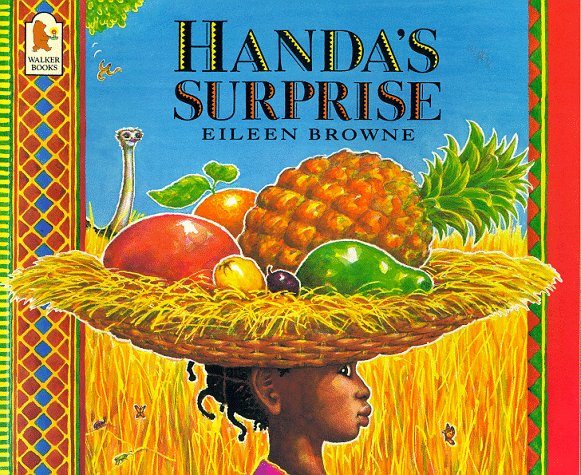
Number 84 is another picture book, hooray! I love a picture book! This time it's the much loved classic, Handa's Surprise, a tale about friendship and fruit! 


This vibrant and cheery book tells the story of Handa, and her journey to her friend's village to deliver a basket of fruit. Handa lovingly packs a selection of fruit in a basket as a surprise for her friend Akeyo. Whilst walking to Akeyo's village however, the fruit is pilfered by a variety of different animals, each keen on a certain piece of fruit! When Handa arrives at Akeyo's village she gets a surprise of her own.... and I can't possibly tell you what that is, or it wouldn't be a surprise anymore, and that's the whole point of the book! 

The book takes it's form from the journey Handa takes, from one village to the next, and each page shows little Handa walking purposefully towards the next page. With every page turn the journey has progressed a little further, until she finally reaches Akeyo's village. Along the way though, Handa's basket is visited by an assortment of wild characters, first a monkey, then an ostrich, a zebra, an elephant, a giraffe, an antelope, and finally a parrot. As each animal steals the fruit, in the background we see the previous animal making off with it's fruity treat from the previous page, creating a wonderful sense of continuity and reinforcing the journey structure of the book.  

Illustrations, of course, play a huge role in all modern picture books, (unless of course you're reading The Book with No Pictures by B.J Novak...). The images in Handa's Surprise present a vibrant and dynamic picture of it's African setting. They are rich with earthy golds and bright blues, allowing you to image the heat of the sun, and the bright sunshine. Handa wears a pink dress with a green pattern, which echoes the colours found in her fruit bowl, and again gives a real feeling of warmth. The pictures have little hidden signposts helping us to read the story, like the retreating animals I mentioned earlier, allowing the child and the reader to talk about the images and discuss the story. The joy of picture books is that there is often more to the image than what you can see straight away, and this leads us to a closer reading of the pictures and greater engagement for the child. 
The pictures can also tell a totally different story to that of the words, which is something we so often see in picture books written post Maurice Sendak's Where the Wild Things Are, the parent of all modern picture books. Prior to Sendak's masterpiece, most picture books relied on the images supplementing the written text, rather than being read in their own right. These days we expect the images to be the main focus of the picture book, and for that we can thank Sendak!
The text and images clearly tell different stories in Handa's Surprise. The written text follows Handa's thought process, as she wonders which fruit Akeyo will like best, but the visual story shows the animals stealing the fruit. If the story was told without the pictures, the story, and in particular the surprise ending, would make no sense! The images and the text work together to create a double narrative, which allows for even more enjoyment of the story, as the listener/reader can see what Handa cannot, and is in on the surprise. 

Overall, I think Handa's Surprise certainly deserves the accolade of 'classic picture' book. The choice of setting is very successful, allowing small children to explore another culture, through it's people, it's produce and it's animals. There will no doubt be fruits in Handa's basket that some children will never have come across before! The stars of the show however, are most certainly the illustrations which are bold and zingy, using colour in a really effective way to make this book instantly attractive. And of course the double narrative depicted through text and images makes for an enjoyable and entertaining story. I think Handa's Surprise is a must-have for all children's bookshelves!

Thanks for reading, Lx

Next up, A Series of Unfortunate Events by Lemony Snicket.

Wednesday, 5 April 2017

No.85 - The Wolves of Willoughby Chase


The Wolves of Willoughby Chase by Joan Aiken is a bizarre book. I'd describe it as a bit like Jacqueline Wilson's Hetty Feather, with hints of classic books such as The Secret Garden. Published in 1962, it also has stylistic echoes of Philippa Pearce's Tom's Midnight Garden, published just five years earlier. Aiken's book is set in a completely fictional era of British history, ruled over by Good King James III, in which the Channel Tunnel has already been built, allowing huge packs of wolves to come through the tunnel into Britain and cause havoc! You can see why I said it was bizarre now can't you!? The first half of the book is rife with wolf attacks, which reminded me of both Wuthering Heights and Dracula. I felt that this book was full of little nods to other texts, whether this was intentional or not I don't know, but it made it all the more enjoyable. 

The story is a dark and mysterious tale, following the misfortunes of young cousins Bonnie and Sylvia. Bonnie is the richer of the two cousins, living in a grand house called Willoughby Chase with everything she could possibly want, and kind, loving parents. Sylvia lives in a small room in London with her elderly aunt, who is struggling to cope with looking after both of them on her meagre income. She sends Sylvia to live with her brother, Bonnie's father, and so the story begins.

Bonnie's parents leave for warmer climes, and her father leaves the two girls, and the estate, in the care of the new governess, and his distant cousin, Miss Slighcarp, who is bad news!! I won't give too much away, but she has her sights on the Willoughby Chase fortune! She instantly transforms life at Willoughby Chase, and telling Bonnie her parents have both drowned, she sends the girls to a school for orphans in a nearby industrial town. Here they are treated terribly, and it was this part of the story that reminded me of Jacqueline Wilson's book about the foundling Hetty Feather. Bonnie reminded me of Hetty in her bold and unbreakable attitude towards this cruel life, plotting escape, keeping herself well fed and looking after Sylvia too, who becomes very ill. Bonnie and Sylvia are helped to escape by Simon, a boy who breeds geese on the Willoughby Chase estate. The three of them travel up to London (with the geese) to find Bonnie's father's solicitor and put everything to rights.

The characters in this book are all really endearing, and we see them change over their adventure, particularly Sylvia who goes from being a very meek and fragile girl, to strong and confident character. Like a Dicken's novel, some of the characters names echo their personality traits, something that I think is useful in novels for children, signposting which characters to side with, and which to dislike! The governess is called Miss Slighcarp, as I've already mentioned, indicating her sneaky, and indeed sly, characteristics, and her accomplice is a Mr Grimshaw, who sounds instantly nasty! Mrs Brisket is the lady that runs the home for orphan girls, and is also in on the plot to steal the fortune. Her name suggests to me a strict and sharp lady, perfect for cruelly disciplining innocent children! In contrast to these characters, the friendly characters in the book seem to have names that echo nature, something that is portrayed as a positive force throughout the book (apart from when the wolves are around!). Bonnie's parents are Lord and Lady Green, an obvious link to nature and the earth, and on their journey the children meet Mr Wilderness the herbalist and blacksmith, and Dr Field, who are both very helpful. Lastly there is Mr Gripe the solicitor, whose name initially indicates that he might be a bad character, and we are not sure who's side he is on until the very end. However, it turns out that he had no idea about the antics of Miss Slighcarp, Mr Grimshaw and Mrs Brisket, and so the whole thing was a bit of headache for him, hence the name Gripe of course! 

Despite being a rather bizarre concept, The Wolves of Willoughby Chase was a really enjoyable adventure story, with hints of other much loved children's books and adult novels woven into the narrative, and recognisable in the characters too. I would recommend this book for adults and children alike. It's a bit scary to start with, with all the wolves and mysterious men, but it becomes much more child friendly as the story goes on, and you end up really routing for the characters. 

Thanks for reading, L x

Next up, a classic picture book, Handa's Surprise.

Wednesday, 29 March 2017

No.86 - Babar The King

It's been a while since I posted anything on here and that's because I've been busy trying to get the first assignment of my MA in, and I am pleased to say that it's finally been posted on its merry way! The focus of the essay was Roald Dahl's classic Charlie and the Chocolate Factory, and I hope at some point to be able to share some my ideas with you. It's safe to say that after all that analysis, I will never view the book in the same way again, whether or not that's a good thing I'm yet to decide!


Anyway, to today's text, Babar the King, one of the Babar the Elephant stories, written and illustrated by Jean de Brunhoff in the 1930s. There are a total of seven Babar books, and the loveable elephant is famous world wide. Starting his life in French, Babar's tales have now been translated into 17 languages, and apparently there are 12 Babar shops in Japan! It's clear to see that this elephant has touched the hearts of many!


Babar The King is the third book in Brunhoff's series. In the two previous books Babar's mother is killed by poachers, he is raised by a kind old lady, he is crowned King of the Elephants, he marries his cousin, travels on his honeymoon in a hot air balloon, is stranded on a desert island, kidnapped and forced into a circus and finally he returns home to win the war against the Rhinos! Phew! The third book sees him settling down in the Land of the Elephants, building his own city called Celesteville (after his Queen), and ruling over his adoring subjects. Babar could be described as a sort of friendly dictator, and the book is not without implicit political undertones. You could say it displays elements of both Colonialism and Communism! 

All is well in the idyllic Celesteville (the closeness to the word celestial is no coincidence here I feel!). Life is good, Babar is a very kind dictator and his subject are happy with their lives, thriving in their new community. The book could go on being wonderfully pastoral and jolly, but no, it rather takes a turn for the worse i'm afraid! The Old Lady, who has been Babar's adopted mother figure, gets bitten by a snake, and is rushed to hospital! Thank goodness Babar had considered state funded medicine for his city! The Old Lady is soon in the care of Dr Capoulosse, but her condition is unstable, and Babar is told she may not make it! Cheery for a children's book that started out so nicely!

However, that is not all Babar has to worry about! On his way home he passes Cornelius's house, and sees that it's on fire and poor Cornelius is stuck on the upper floor!! But thank goodness Babar made sure his city had all the emergency services, because the fire brigade are there putting out the blaze, and rescuing Cornelius. Suffering from smoke inhalation and a nasty wound to the head Cornelius is taken to the hospital too. The fire, we are told, was started by Cornelius throwing a match towards his ashtray, missing, and setting his wastepaper bin alight! Surely a message about the perils of smoking!! 

Babar goes to bed very worried about his friends and in his dreams he is visited by Misfortune, and her other negative companions such as Despair, Anger and Discouragement! However, these are quickly followed by a gang of winged elephant angels who bring joy and happiness, and low and behold when we wakes up the Old Lady and Cornelius are well again! 


If I'm totally honest I'm not sure what message we are supposed to take from all this. Babar didn't do anything wrong, so i'm not entirely sure why he was punished, and idyllic life seems to return straight away, unchanged from the way it was before the accidents. Maybe we are being told not to take a lovely life for granted? Ideas on the back of a postcard please!

All in all, the story is rather old fashioned, not really very inspiring, and even a little confusing. Instead it is the loveable characters and Brunhoff's brightly coloured illustrations that hold the appeal. The personified elephants are a joy to behold in their suits and hats going about their business in their perfectly planned city. 


Next time i'll be looking at Joan Aiken's novel The Wolves of Willoughby Chase.

Thanks for reading, L x


Monday, 16 January 2017

No. 87 - Carrie's War

Hi all!

I finally got around to reading Carrie's War this weekend!


As I'd been avoiding reading it for such a long time I decided that I would try and read it pretty much in one go. Get it over and done with, you might say, not that I can tell you why I was so hesitant to read this book. I think maybe I'd just loss my motivation. I don't often read books in one go, it usually takes me weeks to finish a book, so I came away feeling a bit phased, like i'd been plunged into an alien world! However, this totally immersive experience did help me get to know the plot and the characters much better than if I'd read it in a more stilted way, so that was positive!

This book was not at all what I was expecting. I was expecting a fairly ordinary wartime story of evacuation. A domestic, wholesome, account of daily life in WW2, with a fair share of sadness too. Instead, Nina Bawden's book is a peculiar mix of Goodnight, Mr Tom and a Dickens novel; an interesting combination of domestic and the slightly uncanny. Carrie and her brother are sent to live in rural Wales with God-fearing shop keeper Mr Evans and his sister Lou. Aunty Lou is a lovely but timid lady, frightened of her brother's temper and very keen to please. Mr Evans is a strict, mean man, with strong religious and moral views. Carrie and Nick go to school with the other evacuees in the local chapel, and enjoy the fresh mountain air in their time off. These are all key elements that you might expect in an story about evacuees for the 8-12 age group. However, when the children are sent on an errand to Druids Bottom (no giggling please...), the house of Mr Evan's other sister, whom he disowned when she married, the tone of the story starts to change. On her death bed, Mrs Gotobed (the other sister), is looked after by her beautiful and mysterious housekeeper Hepzibah Green. Also living with the women is Mister Johnny Gotobed, a relative of the family with learning disabilities, and evacuee Albert Sandwich. It is here that it all gets a bit Dickensian! For starters the names have all the quirk of Dickens characters, and Mrs Gotobed has a slight Miss Haversham feel about her! In fact I think all the characters at Druids Bottom could have stepped out of any one of Dickens's classics. Also, due to their rural location, Druids Bottom is still living in the Victorian period, allowing for a clear contrast between the Evans' shop and the rural farmhouse. It is this other setting that made the book stand out for me.

Hepzibah Green is by far my favourite character, a caring, motherly housekeeper, rumoured to be a witch. She is always just about the serve up dinner whenever the children arrive, she is a gifted herbalist, and a very good story teller. She makes Druids Bottom a magical place, and it is around her that the story weaves itself, right up until the very end.

I don't want to give too much away, because I feel I've been doing that too much in my reviews recently, but this story is certainly set in two very different camps. There's the domestic, homely and fairly ordinary world of the Evans's and then their is the magical, valley setting of Druids Bottom, with its myths and intrigue. The actual narrative is also split between two worlds, the past and the present, as the main plot is bracketed by the older Carrie returning to Druids Bottom with her own family. This allows for a lovely little plot twist right at the very end of the book, which I wont give away!

This book was a total surprise, but I actually really enjoyed it! The cover of my copy says that Carrie's War is 'A heartwarming, unforgettable story', a sentiment I was sceptical about to begin with, but I've not been able to shake the characters and haunting plot quite yet. If you're looking for a book that explores what it was like to be an evacuee then this is not the book for you, the war is sort of incidental to the story. Instead this book is an emotional, intriguing tale of friendship, family and loyalty.

Thanks for reading, L x

Next up a firm favourite of mine, one of Jean de Brunhoff's Babar books.

Thursday, 5 January 2017

Children's lit is for life not just for Christmas!

The festive season has been and gone. We're all wondering why there's still Quality Street knocking about, and whether enough time has passed to warrant buying more cheese, and for it not to count as a cheeseboard anymore...? I've just about got my head around what day of the week it is again! Thursday right? Anyway, with all the confusion comes the calm and quiet, which allows you to look back over your presents and truly appreciate what you were given by the ones you love, and what fun you had gifting things to them too. I thought I'd share with you the two beautiful children's books I was given for Christmas, and the three I chose to give to the little people in my life, and what I thought of We're Going on a Bear Hunt.

First up, Harry Potter and the Chamber of Secrets, illustrated by the incredibly talented Jim Kay! 


This book is beyond beautiful! I was keenly anticipating receiving this book for Christmas, hoping that my other half would continue the tradition he set last year when he bought me the first one, and he didn't disappoint! Hooray, and thank you Martin! I came to Harry Potter late but have since found myself totally enchanted by the Wizarding World, and Jim Kay really brings it to life in these books! The Chamber of Secrets is packed with stunning illustrations, bold double page spreads, little intriguing details and fabulous mark making. Magic oozes from it's pages, it's truly spectacular! This book is a real treasure, as is the first one, and I can't wait to see what the next one will look like!


Secondly, a touching picture book about love, loyalty, pride and a piano playing bear. 


I came across David Litchfield's debut picture book The Bear and the Piano on one of my many visits to my local Waterstones's children's section not that long ago, though it was released in 2015. We stood and poured over the enchanting illustrations, and were really touched by the story, reading it aloud like we do with every story we come across (Someone should really employ us!)! So when I unwrapped this book at Christmas I was over the moon! Again, thank you Martin! Here's a little about it.

A bear cub discovers a piano in the forest, and with it a passion for music. Returning to the piano everyday he teaches himself to play, persistently playing until the sounds he makes are beautiful. He gives performances for his fellow bears, until one day some humans suggest he could be a successful concert pianist in the city and so he goes with them. The bear becomes a huge star, packing concert halls every night, but he misses his home. Returning to the forest years later he believes that his family and friends have forgotten him, but in fact they have been keeping up with his progress and have created a shrine to him around his beloved piano, full of his CDs, newspaper cuttings and programs. This book is so tenderly written that I can't help but feel a bit teary when the bear finds his friends have not forgotten him. It's quite moving! In a good way! I urge you all, young and old, to get hold of a copy of this gorgeous book, as it definitely contains a message for all of us.


Now, from one bear to another. I wanted to quickly talk to you about the Channel 4 adaptation of We're Going on a Bear Hunt by Michael Rosen that hit our screens on Christmas Eve. I watched it on Christmas day with my mum and my boyfriend, and while they were happily enjoying the story of a children on an adventure I was a sobbing wreck! It broke me! And here's why!
The whole thing was beautifully done, using hand drawn animation that stayed true to Helen Oxenbury's delightful illustrations in the book. However, what got me was the new additions to the story. The children had clearly lost their Grandpa fairly recently according to this new version, and it was full of sentimental moments where the children remembered him whilst they were walking, and the addition of a recently widowed Granny upped the emotion considerably!  When Rosie broke away from the others in the cave and discovered the bear, made friends with him, and gave him Grandpa's scarf to keep him warm I was holding my tears back! My lip wobbled as the other children dragged the little girl away from the bear and back home. It upset me even more when, as in the book, the children locked the bear out and hid upstairs! By the time the Rosie was telling Granny that she missed Grandpa during the Christmas festivities I was a mess! The end credits rolled and I burst into uncontrollable tears! "The bear is Grandpa", I sobbed, "and the others haven't noticed!" Whether it was the exhaustion of Christmas, or whether this adaptation really had pushed all my emotional buttons it was hard to tell! I thought about it more later on and another thing struck me. Maybe the Bear wasn't Grandpa at all, but a representation of grief. The children ran away from it because they didn't want to face the loss they felt, all accept Rosie who was openly grieving for her lost grandparent. Now, I can hear you all saying "It's just a story Lottie, I can't be that deep!" But one thing my MA has taught me is that there are often a lot more layers to things than you think! But, yes, I probably read to much into it, and besides, that's not how Michael Rosen's story goes anyway! That's just a joyous exploration by children of their terrain and imaginations, without the sentimentality we all have to suffer just because it's Christmas! All in all I was impressed with the adaptation of this classic picture book, and theres a really lovely video about how it was made that you can watch here if you're interested. I just could have done without the emotional breakdown, thats all!!!


I'd also like to share with you the children's books that I gifted this Christmas too. First up Mr Creep the Crook written by Allan Ahlberg and illustrated by Andre Amstutz.


Archie, who is 5, loves Janet and Allan Ahlberg's classic picture book Burglar Bill (a fav of mine, as you all probably know by now!!). So keeping with the spirit of 'cops and robbers' I bought him this book for Christmas. Part of Allan Ahlberg's Happy Families series, a collection of 20 books all with titles like the characters from the Happy Families card game, this book is truly charming! Mr Creep is a bit naughty, much like our friend Burglar Bill! Unlike Bill though, he's been caught! When he escapes from prison he decides to take his whole family, including their rather naughty dog, to the seaside. There he learns that being bad is not all its cracked up to be. Seeing as Archie liked the humour, the story and characters of Burglar Bill I thought this book might a hit, and I really hope it is! Also he's at the age where he's learning to read and the simple text and image layout seemed to me to be a nice beginners read, and if not his sister can always read it to him!


For her, I bought Claude on the Slopes by Alex. T. Smith.


Last year I bought her Claude in the Spotlight and she loved it! So knowing she was a fan of the debonair dog and his sock sidekick I chose her another. I love the Claude books, mainly for their humour, but also for their brilliant illustrations and retro feel. Claude is pretty cute and certainly endearing, and Sir Bobblysock is about as perfect as a slightly camp, anthropomorphised sock can get! The humour is both adult and child friendly, which I think is quite important in a children's book. In this particular book Claude and Sir Bobblysock go skiing, cause an avalanche and have to become mountain rescue!! It's brilliant! I would suggest that these books are a must read for any child between the ages of about 5 and 8, or any age to be honest! You'll love them!


 And lastly, a book for a baby.


When I set out to buy a book for my friends baby boy for his first christmas I had so many ideas! I wanted to get him a real classic, a beautiful book that he'd treasure, and then I remembered, 1- he's only very small, and 2- he might have a lot of the go-to classics already, and I didn't want to double up. I came across Peekaboo Zoo by Kate Merritt quite unexpectedly and I instantly fell in love with it's bright, bold baby friendly illustrations and fun flaps to lift (I love a 'lift the flap' book!). But the clincher for me was the little mirror on the last page, which lets the baby see their own reflection after saying peekaboo to all the animals throughout the book. This was a lovely touch, and also a nice interesting visual element for James too after the static illustrations. Reflections are fascinating things after all!


Ok, so there you go, a round up of the children's book I gave, received and enjoyed over Christmas.
I hope you liked it!

Thanks for reading! L x