Monday, 7 August 2017

Going 'Into the Forest'

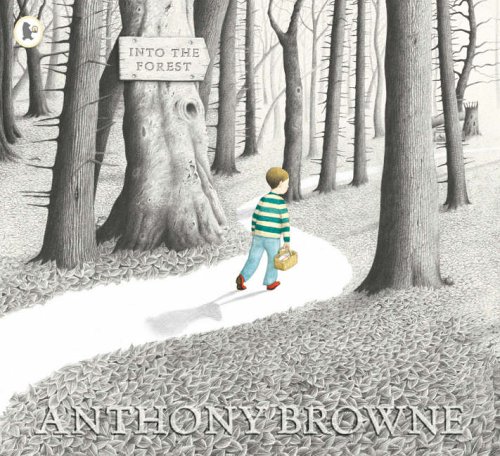
This is Anthony Browne's picture book Into the Forest.


I came across this book whilst doing some research for an essay, and I was instantly intrigued by its illustrations. I starts in colour, and then as the boy enters the forest his world desaturates and we are left to navigate a monotone tangle of spiky trees and hidden fairy tale references. The obvious fairytale link in this story is Little Red Riding Hood, but there are also references to Jack and the Beanstalk, and Hansel and Gretel too, amongst others. I looked at this book quite a bit during my research, but since then hadn't really given it a second thought, until this week.

My Dad had just purchased a bit of woodland and I'd gone up to visit him and take a look! In my head this woodland was deciduous, a green and mossy landscape, friendly and inviting. Instead, this woodland was pine, thick, dense and dark. I stood in the absolute silence, looking at the monumental trees around me, and found myself transported to the pages of Anthony Browne's book.


The likeness was incredible! Well, to me anyway! The short pointy branches jutting out of each trunk, the desaturated colours, the paths cut through the trees; I felt like I was standing in a fairytale.


I kept expecting to look around and see the leg of a giant rather than a tree-trunk, a little figure scuttling off into hiding, or a set of eyes watching me. Anthony Browne is amazing at hiding little things like these in his images, quirks that you never see the first time you look, but make you smile the second. I was half expecting to see magical things in these photos!


It just goes to show that books play a huge part in the way we perceive the world. Have you ever found yourself somewhere you feel you know, only to realise that's because you've read it? Or imagined a place in a book as somewhere you already know? The wonderful thing about reading is that our memories keep little snippets of the information we've read, imagined or seen, hidden away ready to inform our experiences when we least expect it. Having stood in Anthony Browne's forest I can testify that that is a magical thing! 

Thanks for reading, L x


Friday, 28 July 2017

No. 80 - Old Possum's Book of Practical Cats

This post marks a huge milestone in my book reading journey! Old Possum's Book of Practical Cats by T.S Eliot is number 80 on the list, which means that I am 20% of the way through my challenge! Hurrah! I'm really enjoying reading all the books, whether I've read them before or not. Coming up are some books that I fondly remember, and some that I've never even heard of, so that should be fun! I've also got a few other things up my sleeve too, so watch this space! 


T.S Eliot was one of the most famous poets, critics and playwrights of the twentieth century. Despite having written some of the most infleuntial poetry and prose works of that time, surprisingly his best selling book has been Old Possum's Book of Practical Cats! This intriguing work about the nature of cats started its life as a selection of poems created to entertain the children of Eliot's close friends. It was later published as a book by Faber, in 1939. I love the cover of the Faber edition above, being quite the fan of an Axel Scheffler drawing! 

These days I would say we are most familiar with the poems as being the lyrics used in Andrew Lloyd Webber's musical Cats, which was a very successful stage show indeed. So it was tricky to read the poems without putting them to the tunes that I knew! Especially Macavity! It helped to listen to T.S Eliot reading the poems himself, which you can do here! It's definitely worth a listen. 

In the 14 poems in this collection we meet an array of characters; Mr Mistoffelees the Original Conjuring Cat, Gus the Theatre Cat, Skimbleshanks the Railway Cat, Mungojerrie and Rumpleteaser, Jennyanydots, Rum Tum Tugger, the Jellicles Cats, Old Deuteronomy, the Pekes, the Pollicles, The Great Rumpuscat, Macavity the Mystery Cat, and Bustopher Jones the Cat About Town. By far the best thing about these poems is the amazing names Eliot has given to all the cats, and the way he talks about those names. In the first poem 'The Naming of Cats', he explains that cats have three names, an everyday name such as Peter, James or George (fair enough), then a name that's a little more extravagant than that, for example, Munkustrap or Bombularina (woah!!), and finally a name that only they know, and we will never find out! To my great pleasure, I have just read that Eliot was most certainly a 'cat person' and some of his cats had equally as marvellous and peculiar names! Eliot had cats called Pettipaws, Jellylorum, George Pushdragon, and Wiscus!*

This collection of poems was a little formal in language and tone due to its age, but other than that it was a great read. Each poem is a little cameo of the eccentric feline characters Eliot has dreamt up. My favourite by far is Gus the Theatre cat, who you can just imagine recounting his tales of the stage to a captive audience in a pub! I also love that Gus is short for Asparagus, another fabulous cat name! I would thoroughly recommend that there be a copy of Old Possum's Book of Practical Cats on every bookshelf! One like the Faber edition above would be perfect for older children (and adults of course!), and for younger ones I would recommend getting one or two of Arthur Robins's picture book versions, which focus on just one poem per book. So go forth and buy! 

Whilst I'm here talking to you all about poetry, I'd quickly like to say a few words about the importance of poetry for children. There have always been poetry anthologies for children, and fabulous children's poets out there, but for some reason prose has always had the upper hand. Poetry books are valid 'reading books' for children just as any other texts are, and I think sometimes we forget this. I was recently volunteering in my local library helping with the Summer Reading Challenge (anyone with children should get them down to the library and to sign them up asap, but more about that another time!). Whilst showing a little girl around the children's department she asked me if there were any poetry books? I'm ashamed to say that it almost took me by surprise, but then I realised that that was as valid as any of the other books I was showing her, and good on her for wanting to explore something more than a prose story. Aside from listening to poetry as a child, my main experience of it was when I got secondary school. Suddenly we were analysing metre, language and imagery, picking poems apart to see what they were made of. It became a chore, albeit one I actually quite enjoyed, but still associated with the stress of exams and grades. So, I suppose what I'm trying to say is that children should be encouraged to explore poetry for the fun of it, far before they reach the age where it becomes just another thing they need to master in order to jump through academic hoops. They need to be able to enjoy a poem just because of the way it sounds, and bask in the images that it conjures up in their imaginations, without having to analyse all the why's and how's. The Book Trust have a lovely list of their favourite poetry books for children here, which I recommend having a look through if you're interested. There's some great books on it, including Arthur Robins's version of Mr Mistoffelees, and Julia Donaldson's Crazy Mayonnaisy Mum, which is the poetry book that my little library visitor chose to take home. 

Thanks for reading, L x

Next time, it's The Little Prince by Antoine de Saint-Exupery. 


* This and some of the other information in this post came from a wonderful article by John Sutherland on the British Library website, which you can find here. It talks about the background and context of Old Possum's Book of Practical Cats and is well worth a read. Arthur Robins's

Friday, 21 July 2017

No.81 - The Hundred and One Dalmatians


I will begin with a word of warning, never, I repeat, NEVER trust a Disney film! As we’ve previously discovered in my post about Mary Poppins, Walt Disney changed everything! The characters you thought you knew are totally different when you read the book, even the story itself can be hard to recognise once you strip back the perky animation, catchy songs and overly polished storylines. So if you’re reading this humming “Cruella De Vil” (which I am!) then stop right now! There are no jazzy tunes in this story, just a tale of bereft doggy parents and the extent of their love!  Ladies and Gentlemen, I give you Dodie Smith’s The One Hundred and One Dalmatians, a classic of children's literature, not just a Disney film!


Now, I'm not criticising the Disney film, in fact it's one of my favs, but reading the book just makes you realise how many liberties Mr Disney took when he made his films. So let me start by telling you a few of the differences between the book and the beloved film.

Firstly, Perdita is not the mother of the puppies, this is instead a lovely dog called Missus. When Missus has 15 puppies and can't feed them all at once Perdita is brought in as a surrogate mother to half the pups. But her story is not a happy one. She is found starving on the side of the road, after setting out to find her puppies who have been stolen. So when Missus and Pongo's puppies are stolen too she goes through the grief all over again! You can see why Disney chose to leave this out of his film!

Secondly, the story is told mainly from the dogs point of view, in fact the humans barely even feature, and when they do they are referred to as the dogs 'pets', rather than the other way around. This is a nice touch, which gives the book a very different feel to the film. The animals in the book are cleverly anthropomorphised so that you follow their journey, and feel their emotions just as you would a group of human characters. My only complaint would be that, although written by a woman, the book is a little lacking in its portrayal of its female characters. Poor old Missus is as ditsy as they come!

One thing that doesn't differ from the film however, is the evilness of Cruella De Vil (I can't type her name without singing the song!)! She is horrid! In the book we are introduced to her long suffering husband, who is a furrier ( he makes furs), and we learn that she forces him to make furs out of anything she fancies! Unlike Cruella, he is not an evil mastermind, but stuck under the reign of his nasty wife! Another strange fact about Cruella is that she loves pepper, as one of the puppies finds out when he bites her and she tastes hot and peppery! Everything about her is vile and cruel, as her name suggests!

It turns out that Cruella is hoarding Dalmatian puppies at her ancestral home, Hell Hall. She is keeping them well fed and happy until they get big enough to be killed and skinned!! Using their own doggy communication system, the Twilight Barking (which you may remember from the film), Missus and Pongo discover that there puppies have been taken to the hall, and they set out to rescue them.... but come back with a lot more than they set out for!

This is a delightful book, and I would thoroughly recommend it to anyone! The characters are beautifully written and the language and tone is in no way condescending to it's young audience. It is quite a grown up book in many ways, but the story has all the appeal of a children's classic. And what's more, there's a sequel!

Thanks for reading, L x

Next up is a collections of poems, something new to the blog. I will be looking at Old Possum's Book of Practical Cats by T.S Elliott.

Sunday, 4 June 2017

No.82 - Emil and the Detectives

Emil and the Detectives is a classic children's book that I had never heard of until I saw it in this list. I suppose that's because it's a German children's classic and having never really read translations I was yet to discover it. When I initially read the title I was interested in reading what I thought would be a child's adventure in the world of professional sleuthing. I pictured young Emil joining forces with a policeman or detective, or maybe even being the reason for the sleuthing in the first place! I was close, but no cigar!


Instead, Emil, who is unwittingly robbed on the train to Berlin, whilst he is sleeping, tracks down his thief on the streets of Berlin with help from a group of local boys. Emil and the Detectives has a undertone of Dicken's Oliver Twist, or the traditional boys books of the late 19th and early 20th century. It has the feeling of both a school story and an all boys adventure tale combined. There is espionage, a stake out, a thief with multiple identities, and a fair bit of intruige. The book takes a while to get into this, and to start with the prose style is rather staid due to its translation from German to English. My particular edition was translated in the 50s, but the book was actually first published in the UK in 1931. With the slow start I was initially a bit sceptical about this book. How is this a classic? It's so boring! No child would speak like that! He's such a goody goody! But, as the story developed I found myself enjoying the bizarre nature of Emil's adventure, with its dodgy looking criminal and its eccentric child characters! 
Intent of getting back his £7, Emil follows the suspicious looking Mr Grundeis (who looks every bit the spiv if the illustration is anything to go by!) off the train and into the middle of Berlin, a city where he has never been before. Soon enough though he is aided in his shadowing of the criminal by the brilliant Gustav, a boy with a motor horn! The horn is never explained but appears to be young Gustav's trademark and he goes around honking it all over the place! Gustav is the Artful Dodger to Emil's Oliver, and he soon rallies a whole group of boys keen to help Emil catch his thief! Once assembled they make a plan, which is engineered by the intelligent one, who of course wears glasses and is known as the professor! This book really has all the elements you'd expect from a boy's adventure story! However, the wild card in all this is Emil's cousin Pony, who is, shock horror, a girl! She dips in and out of the narrative, never fully included in the gang; though it is clear she has more bottle than some of the boys! It is hard to decide whether you should like Pony or not, she 's a bit pushy and pretentious, but also feisty and go getting, unlike the other female characters who are all a bit limp or overly domestic. Emil on the other hand is overly polite and moral, a little unworldly, and the boys make fun of his suit, yet he comes out as the hero of the story, despite being really quite a dull character! 


Although I had my initial doubts, I actually really enjoyed this book. I can see why it would be classed as a classic, as it has all the hallmarks of a popular book of its time. Personally, I enjoyed all the quirky characters and the slightly absurd nature of the story line! If you get past the slow start, then this book is a little gem! 

Thanks for reading, L x

Next time, it's The Hundred and One Dalmatians by Dodie Smith, which I am very much looking forward to reading! 


Thursday, 4 May 2017

No. 83 - A Series of Unfortunate Events


Unfortunate could not be more fitting, in fact it could even be thought an understatement, considering what happens to the children in these books! Many of you will be familiar with Lemony Snicket's series through the recent adaptation of the stories for Netflix, and you may even have seen the 2004 film starring Jim Carey as creepy Count Olaf. I'll be honest though, the popularity of A Series of Unfortunate Events bemuses me rather.... 

As you will know from reading my previous posts I'm not really a fan of anything that's a bit dark. I like my books jovial and heartwarming, although I also like a bit of intrigue and mystery, but we'll save that for another day! I chose the start right at the beginning with the Lemony Snicket books and read the aptly named The Bad Beginning for this post. Now, I don't know about you, but I don't feel instantly enamoured with a book that warns me off on the first page! The Bad Beginning starts "If you are interested in stories with happy endings, you would be better off reading some other book."*. Great, I thought! This book is not for me.... I read on..... "In this book, not only is there no happy ending, there is no happy beginning and very few happy things in the middle."**. This was going to be a jolly read then! But against my better judgement I read on! And frankly, I shouldn't have done! The book was depressing from page one, until the very last, just as it said! 

I'll give you brief outline of the misfortunes that befall the Baudelaire children.....


SPOILER ALERT, if you plan to read the books or haven't watched the Netflix version yet!

  • Firstly, the children's parent die in a housefire! They loose their home, their parents and all their possessions. Not the best start to the story I can tell you. 
  • Then they get taken in by the executor of their parents' Will, a Mr Poe (who coincidently shares his name with the great gothic poet....!? I think not!) His wife makes them wear horrible itchy clothes, frankly adding insult to injury! 
  • The Will states that they must be raised by a relative... enter the despicable Count Olaf.... Da Da Daaa! 
  • The Count is EVIL!
  • His cronies are EVIL too! And really rather odd.... There is a man with hooks for hands, and bald man with a very long nose, an androgynous giant, and two very pale ladies. Along with the strange Count Olaf, they wouldn't have looked out of place in a old travelling circus...
  • The only upside to living with Olaf is the nice lady who lives next door, who is a judge and has a library! I was willing the children to tell her about their mistreatment, but of course they don't! If they did the story might have actually perked up!
  • Olaf hatches a plan to get the children's fortune (they are very rich, see). This involves getting Violet, the eldest, to marry him so he is entitled to the fortune! 
  • She must go ahead with it, or her baby sister Sunny will be dropped from a thirty foot tower to her death..... Cheery! 
  • Violet manages to trick the Count, and the marriage is never declared legal! Mr Poe orders Olaf's arrest and it all ends happily ever after with the children going to live with the nice judge. Well thats good news, surely, I hear you cry... oh no... sorry, no can do..... 
At this point the book offered me a way out of this cycle of doom... "If you like, you may shut the book this instant and not read the unhappy ending that is to follow. You may spend the rest of your life believing that the Baudelaires triumphed over Count Olaf and lived the rest of their lives in the house and library of Justice Strauss..."***. Oh, was I tempted!!

But alas, I wouldn't be fulfilling my challenge if I didn't read to the end of book, so unfortunately I had to.... and the declaration on the first page was not a lie! There was no happy ending! Count Olaf escaped capture, to terrorise again! And the children had to go back to the Poe's house to go into the care of another relative, but who.....?

It's safe to say that I didn't enjoy The Bad Beginning, this book was not for me! But maybe i'm missing something, because these books, the film and the subsequent TV series seem to be very popular!

Thanks for reading, L x


(*Lemony Snicket, *p.1, **p. 1, ***p.156)

No.84 - Handa's Surprise

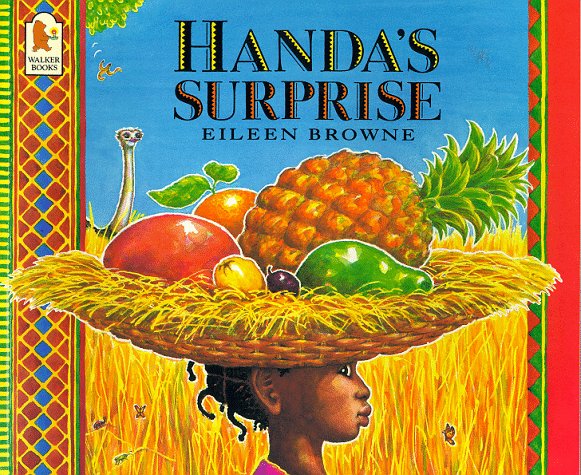
Number 84 is another picture book, hooray! I love a picture book! This time it's the much loved classic, Handa's Surprise, a tale about friendship and fruit! 


This vibrant and cheery book tells the story of Handa, and her journey to her friend's village to deliver a basket of fruit. Handa lovingly packs a selection of fruit in a basket as a surprise for her friend Akeyo. Whilst walking to Akeyo's village however, the fruit is pilfered by a variety of different animals, each keen on a certain piece of fruit! When Handa arrives at Akeyo's village she gets a surprise of her own.... and I can't possibly tell you what that is, or it wouldn't be a surprise anymore, and that's the whole point of the book! 

The book takes it's form from the journey Handa takes, from one village to the next, and each page shows little Handa walking purposefully towards the next page. With every page turn the journey has progressed a little further, until she finally reaches Akeyo's village. Along the way though, Handa's basket is visited by an assortment of wild characters, first a monkey, then an ostrich, a zebra, an elephant, a giraffe, an antelope, and finally a parrot. As each animal steals the fruit, in the background we see the previous animal making off with it's fruity treat from the previous page, creating a wonderful sense of continuity and reinforcing the journey structure of the book.  

Illustrations, of course, play a huge role in all modern picture books, (unless of course you're reading The Book with No Pictures by B.J Novak...). The images in Handa's Surprise present a vibrant and dynamic picture of it's African setting. They are rich with earthy golds and bright blues, allowing you to image the heat of the sun, and the bright sunshine. Handa wears a pink dress with a green pattern, which echoes the colours found in her fruit bowl, and again gives a real feeling of warmth. The pictures have little hidden signposts helping us to read the story, like the retreating animals I mentioned earlier, allowing the child and the reader to talk about the images and discuss the story. The joy of picture books is that there is often more to the image than what you can see straight away, and this leads us to a closer reading of the pictures and greater engagement for the child. 
The pictures can also tell a totally different story to that of the words, which is something we so often see in picture books written post Maurice Sendak's Where the Wild Things Are, the parent of all modern picture books. Prior to Sendak's masterpiece, most picture books relied on the images supplementing the written text, rather than being read in their own right. These days we expect the images to be the main focus of the picture book, and for that we can thank Sendak!
The text and images clearly tell different stories in Handa's Surprise. The written text follows Handa's thought process, as she wonders which fruit Akeyo will like best, but the visual story shows the animals stealing the fruit. If the story was told without the pictures, the story, and in particular the surprise ending, would make no sense! The images and the text work together to create a double narrative, which allows for even more enjoyment of the story, as the listener/reader can see what Handa cannot, and is in on the surprise. 

Overall, I think Handa's Surprise certainly deserves the accolade of 'classic picture' book. The choice of setting is very successful, allowing small children to explore another culture, through it's people, it's produce and it's animals. There will no doubt be fruits in Handa's basket that some children will never have come across before! The stars of the show however, are most certainly the illustrations which are bold and zingy, using colour in a really effective way to make this book instantly attractive. And of course the double narrative depicted through text and images makes for an enjoyable and entertaining story. I think Handa's Surprise is a must-have for all children's bookshelves!

Thanks for reading, Lx

Next up, A Series of Unfortunate Events by Lemony Snicket.

Wednesday, 5 April 2017

No.85 - The Wolves of Willoughby Chase


The Wolves of Willoughby Chase by Joan Aiken is a bizarre book. I'd describe it as a bit like Jacqueline Wilson's Hetty Feather, with hints of classic books such as The Secret Garden. Published in 1962, it also has stylistic echoes of Philippa Pearce's Tom's Midnight Garden, published just five years earlier. Aiken's book is set in a completely fictional era of British history, ruled over by Good King James III, in which the Channel Tunnel has already been built, allowing huge packs of wolves to come through the tunnel into Britain and cause havoc! You can see why I said it was bizarre now can't you!? The first half of the book is rife with wolf attacks, which reminded me of both Wuthering Heights and Dracula. I felt that this book was full of little nods to other texts, whether this was intentional or not I don't know, but it made it all the more enjoyable. 

The story is a dark and mysterious tale, following the misfortunes of young cousins Bonnie and Sylvia. Bonnie is the richer of the two cousins, living in a grand house called Willoughby Chase with everything she could possibly want, and kind, loving parents. Sylvia lives in a small room in London with her elderly aunt, who is struggling to cope with looking after both of them on her meagre income. She sends Sylvia to live with her brother, Bonnie's father, and so the story begins.

Bonnie's parents leave for warmer climes, and her father leaves the two girls, and the estate, in the care of the new governess, and his distant cousin, Miss Slighcarp, who is bad news!! I won't give too much away, but she has her sights on the Willoughby Chase fortune! She instantly transforms life at Willoughby Chase, and telling Bonnie her parents have both drowned, she sends the girls to a school for orphans in a nearby industrial town. Here they are treated terribly, and it was this part of the story that reminded me of Jacqueline Wilson's book about the foundling Hetty Feather. Bonnie reminded me of Hetty in her bold and unbreakable attitude towards this cruel life, plotting escape, keeping herself well fed and looking after Sylvia too, who becomes very ill. Bonnie and Sylvia are helped to escape by Simon, a boy who breeds geese on the Willoughby Chase estate. The three of them travel up to London (with the geese) to find Bonnie's father's solicitor and put everything to rights.

The characters in this book are all really endearing, and we see them change over their adventure, particularly Sylvia who goes from being a very meek and fragile girl, to strong and confident character. Like a Dicken's novel, some of the characters names echo their personality traits, something that I think is useful in novels for children, signposting which characters to side with, and which to dislike! The governess is called Miss Slighcarp, as I've already mentioned, indicating her sneaky, and indeed sly, characteristics, and her accomplice is a Mr Grimshaw, who sounds instantly nasty! Mrs Brisket is the lady that runs the home for orphan girls, and is also in on the plot to steal the fortune. Her name suggests to me a strict and sharp lady, perfect for cruelly disciplining innocent children! In contrast to these characters, the friendly characters in the book seem to have names that echo nature, something that is portrayed as a positive force throughout the book (apart from when the wolves are around!). Bonnie's parents are Lord and Lady Green, an obvious link to nature and the earth, and on their journey the children meet Mr Wilderness the herbalist and blacksmith, and Dr Field, who are both very helpful. Lastly there is Mr Gripe the solicitor, whose name initially indicates that he might be a bad character, and we are not sure who's side he is on until the very end. However, it turns out that he had no idea about the antics of Miss Slighcarp, Mr Grimshaw and Mrs Brisket, and so the whole thing was a bit of headache for him, hence the name Gripe of course! 

Despite being a rather bizarre concept, The Wolves of Willoughby Chase was a really enjoyable adventure story, with hints of other much loved children's books and adult novels woven into the narrative, and recognisable in the characters too. I would recommend this book for adults and children alike. It's a bit scary to start with, with all the wolves and mysterious men, but it becomes much more child friendly as the story goes on, and you end up really routing for the characters. 

Thanks for reading, L x

Next up, a classic picture book, Handa's Surprise.