Showing posts with label Little Women. Show all posts

Wednesday, 10 August 2022

Comfort Zones in Children's Literature

Comfort zones are a big thing for everybody. Whether you're a child or an adult, there's something about moving from the unknown to the known that scares us all, deep down. That step away from the stable and secure, be that trying something new, going to school for the first time, or starting a new job. It's scary! What will it be like? How will you cope? Who will you meet? Endless questions! At the moment I am feeling somewhat stuck in a comfort zone that I have neatly curated for quite some time, and it made me think about how comfort zones are portrayed in children's literature, because of course, this is often my first route of enquiry.

My first thought was of dear Mole in The Wind in the Willows, spring cleaning his little hole, when all of a sudden he decides enough is enough, "Hang spring-cleaning" he mutters and scrabbles out into the open fields above him, ebracing life above ground. He does it, pushes out of his comfort zone! He has moments of fear, where no doubt he wishes he could disappear underground, don't we all! But most importantly Mole shows us that's its ok to falter, and its our inner strength that helps us continue onwards.


Then I though of timid Piglet, always one step behind Pooh bear, his living, breathing comfort zone. A friendship that was more than just two pals. They made each other braver and stronger somehow and together they were able to traverse the boundaries of their comfort zones to hunt woozles and heffalumps, as well as deal with Tigger on a daily basis! 
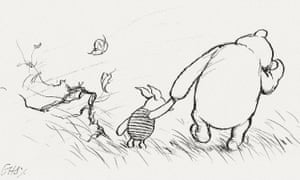


Both Mole and Piglet show us that courage comes just beyond your comfort zone, and it's always easier with the support of others. 

As my brain delved deeper into the idea of comfort zones in children's books I starting thinking about the concept of growing up and how many children's books written during the Golden Age of children's literature made a clear distinction between child and adult, and many books such as Little Women, were written to eductate children in the art of becoming an adult, or navigating the transition between childhood and adulthood. In Little Women Alcott is showing us what it is like to grow up, the moral trials and tribulations, as well as the practical expectations for the 19th century woman. We see the girls' grow away from the comfort zone of Marmee to become women in their own right, however, I would argue this is only successful for Amy and Jo, who take up independant careers and an artist and teacher, respectively. Beth, unfortunatley never makes it to adulthood, she is too entrenched in the comfort zone of home that she is forever trapped there, always rememebered as the shy, sickly child she was in life. Meg becomes a comfort zone in her own right, taking on the Marmee role as the book progresses, something more expected at the time the novel is set. 


On the reverse of this is Peter Pan, J.M Barrie's 'Boy Who Never Grew Up'. His relationship with adulthood is very different. He refuses to accept the notion of growing up, the biological fact that children grow into adults. A lot of this characterisation is down to Barrie's own relationship with adulthood and his own personal comfort zones. Barrie was traumatised by his brothers death when he was a child, and the subsequent effect this had on his mother. He himself retained some childlike traites in his adult personality, an attempt a reliving the life he had before his early trauma, his comfort zone. Many historians have suggested that Barry was asexual, and that his attitude towards growing up was closely linked with his sexuality. He believed that once you had crossed the boundary into adulthood (mainly through sexual acts) that there was no way of getting back to childhood. This idea can be seen wholeheartedly in Peter Pan. The nursery is a comfort zone, and although the Darling children travel from it's confines to Neverland, this is Peter's domain, where adulthood (depsite Wendy playing at Mother) is no where to be seen. A fantasy comfort zone that insures adulthood will never get in. 


Thinking more on the idea of comfort zones I also considerd the idea of the physical book too. Do you have a book that you return to again and again? An escapism that has in some way become a comfort zone. I know I do. For me it's the world of Winnie the Pooh, and a fictional diary called A Diary of a Nobody by George Grossmith. When i'm a bit down, or unsure what to read next, I will always reach for one of those books. They make me laugh, and slipping into their pages is like slipping into a pair of snuggly socks or clean sheets. It's magical, and of course extremely comforting! For children there will always be books that they will want to read again and again, or a series that they really get hooked on. For adults you may return to books you read as a child to feel comforted or reassured. It's natural for humans to want that comfort, support and reassurance of the known. This is why stepping outside our comfort zone is really hard. 

The children's adventure or school story genres often hold an element of comfort zone expansion, of pushing beyond what they know or what parents have set as the boundaries, and often the protagonsists of these books do it without batting an eyelid! The innocence of childhood in these stories seems to take away any fear of the unknown that we might have as adults. Re-reading some books I often find myself projecting my own fears and anxiety onto the characters. Why are they doing that? What will be the consequences of those actions? Who should or shouldn't they trust? Is this blatent disregard for the unknown good for children? Is it teaching them to have a growth mindset or to be plain reckless!? Nowadays I think there is a lot more phsychology involved in the actions of characters in children's books. Children are no longer just 2D stereotypes in stories that like to sail, or act the spy. Children's books now address a lot broader range of themes, questions and societal issues, all of which at points will deal with the idea of the comfort zone in some way or another. Books for children, and more often teens, nowadays address issues such as loss, grief, sexually, violence, crime and drug abuse. There is almost no topic out of bounds anymore! They are instruction guides to growing up, cheat sheets for big life decisions; books for big emotions. Children growing up today are so incredibly lucky that they have literature that addresses issues they might come across and helps them navigate life. Comfort zones have been replaced with topics that make us think and feel, rather than settle down in a cosy corner. I sometimes wonder if this is a good thing? But I suppose things move on. Like life. We must move on, push forward out of that comfort zone like Mole; free ourselves and good things will happen.

"This day was only the first of many for the emancipated Mole, each of them longer and fuller of interest as the ripening summer moved onward." 

Thanks for reading, L x

Friday, 19 February 2021

No. 58 - Anne of Green Gables

So, here we are again, in the depths of another national lockdown. I'd like to say I'd found myself turning to books for solace, for escapism and adventures with old friends, but sadly this has not been the case. I long to dally with Pooh and Piglet, and imagine I'm Miss Honey teaching the amazing Matilda, but alas.... Instead I have been very busy working, and trying my best to keep my creative juices flowing in my spare time. There really has been no time for reading! This lockdown feels very different to the last, where I lost myself in the pages of friends old and new, and sat sunning myself in the unusually warm April air listening to audiobooks. 

I suppose I'm trying to apologise to you, and to myself, for not getting on with this blog after such a good start last year. The blog is in it's 5th year now, and although I'm nearly half-way through the list, I feel like I've slowed down again. I'm going to try and change this! I will try and liven up the Instagram page more (@the.littlebookworm if you're interested), and maybe even try a few live readings, or Youtube clips if I'm feeling brave! I still have lots of ideas I want to share with you all, I just need to find the time! 

It's taken me a long time to get through it, but finally I have finished book number 58, Anne of Green Gables by L.M Montgomery. 

How beautiful is this cover!?


Now, I know lots of people have fond memories of this book, and it appears again and again on lists of the best children's books, but I'll admit that I didn't enjoy this book. I found Anne a little annoying, and the tone of the writing somewhat patronising. But as I have said on many occasions whilst writing this blog, I never expected to like every book on the list! 

I'll start with a quick synopsis. Set in 19th century Canada, the story focuses on our heroine Anne Shirley. Orphaned Anne is sent to live with the dowdy Marilla Cuthbert and her brother Matthew. Anne is full of flights of fancy and imagination, quite a contrast to the straight talking, serious Cuthberts, in particular the matriarch Marilla. The story then follows Anne's new life in Avonlea, her schooling, her friendships, the ups and downs of growing up. It has all the hallmarks of the typical coming of age story; success through adversity, rags to riches, self-made success and determination. We see it time and time again in children's literature, though quite often the characters are boys. 

Instead, L M Montgomery follows in the footsteps of American author and children's literature VIP Louisa May Alcott. Like Alcott's March sisters, Anne is quite the character, with her very own set of opinions about life. She has her vices, much like Alcott's girls, in particular vanity! She is always wishing she was someone else, or her hair was a different colour, or her nose a different shape! Unlike Alcott's sisters however, I never really felt like Anne lost these traits, she remained just a little self-obsessed throughout the whole book! Even at the end, despite seeming selfless she gets her own way!

And it wasn't just her actions that I found hard to endure, but the way the book was written! I'm sorry, but I told you this book was a tough read! Anne talks way too much! And I mean waaaay too much! Most of the first part of the book is dialogue, just Anne chatting about everything and anything! I understand that this is meant to show her excitement about her new life, and her realisation that life will be good to her in Avonlea, but even so, sometimes you just need a break for breath! If I was a child reader I think this incessant chatter would be something I would struggle with and find a little overwhelming to read. For others, it may not bother them, after all it is part of creating Anne's character I suppose. But I personally found it a bit too much. 

The story itself bumbles along fairly predictably, with a new adventure in Anne's life in each chapter. She has some rather predictable domestic accidents, a few physical accidents, she worries about dresses, bosses people around, and is extra (as the kids say), about just about everything! 
 
When Montgomery wrote this book however, Anne was a radical character, forging her own path in a man's world. Through her own intelligence, hard work and determination, Anne becomes a teacher, one of the few accepted vocations available to women at the time. I think she would have got on with Jo March don't you? Of all Alcott's Little Women, Anne definitely reminded me most of Jo. She is feisty, fiercely intelligent, not scared to speak her mind and insanely aspirational and driven! I wonder whether this is purely coincidence, or was Montgomery inspired by Alcott's novel? 

If you like Little Women, then the chances are you will enjoy Anne of Green Gables, it is very much  part of that canon. Although I didn't personally like it, I can see how it would appeal to others, and how Anne's journey from a self-indulgent, orphaned fantasist, to a slightly less self-indulgent, successful, ambitious young lady has come to be an enduring classic. 

Thanks for reading, L x

Next up one of my absolute favourites, the wonderful Elmer, by David McKay!


Sunday, 3 April 2016

Extremely Wise Words

Hello!

Sorry its been a bit quiet on here lately, I've been pretty busy and I've not had as much time for reading as I would have liked. However, the reading of Inkheart is going well, and I'm absolutely loving the spell binding story, centred around the book loving heroine Meggie!

Whilst I'm busying away I thought I'd keep you amused with a post about my most loved quotes from children's books. (It's a bit of a long one, but I hope you enjoy it!)

As those of you who know me will already know I suffer quite badly from an anxiety disorder. You could say that my love of children's books stems from a time when life was easier, when I had less to worry about and things were simpler, and I think you'd be right in some respects. By sitting down with a beloved children's book I am often transported back to memories of reading that book as a child, and I revisit favourites again and again for that fondness and familiarity; they are my old friends. Now I think of it, most of those old friends took the shape of bears! Winnie-the-Pooh, Paddington, Teddy Robinson, Old Bear, Little Bear, Bramwell Brown! My Ursine pals were always there! But there were others too, like Charlie Bucket, Esiot Trot and Matilda, Ratty, Moley and Toad, and who could forget Pongwiffy the Witch!

Considering my literary pals, it occurred to me how much impact a book can have on a child, and how authors convey messages to their young readers. Much of what is written for the young is invaluable in terms of teaching life lessons, and addressing difficult situations. Just take some of the topics teen fiction covers these days! As an adult however, I think we can still look to children's fiction for inspiration and advice, so I thought I would share with you some of my favourite quotes.

1. Winnie-the-Pooh by A.A. Milne -


When I first came across this quote, not that long ago, it made me cry! It seemed to sum up everything I was feeling and the things that I needed to remind myself on a daily basis. I shy away from a lot because I don't feel brave enough, and I often underestimate how much I can cope with life. There are many other beautiful quotes to be found in the Winnie-the-Pooh stories, but this one will always resonate with me the most, and I like to keep it on my desk at all times to remind myself that I am ok, if only I remember what A.A Milne once said.


2. Charlie and the Great Glass Elevator by Roald Dahl-


I love this quote! It's an important one for everyone to remember! Please be silly, just because you're grown up doesn't mean you must stop being daft! Just look at Willy Wonker there in that wonderful Quentin Blake illustration, he's the epitomy of jollity. This quote pops into my head quite regularly and reminds me to loosen up a bit!


3. Harry Potter and the Philosopher's Stone by J.K Rowling -

Good old Dumbledore, full of all wise words. These words in particular resonate with me. I've spent years wishing that my anxiety hadn't held me back, that I'd gone to university, that I'd done an arts course, that I'd been the person that I always believed that I would be, and its only recently that I've been honest enough with myself to admit that these dreams were not worth dwelling on anymore. Instead, I realised that I should be happy with what I've got and how my life is now, to look forward and not back. Dumbledore's wise words make so much sense now, because whilst you're dwelling on what you wished might have been you're are missing what is right there in front of you and it's passing you by. It's a valuable lesson people! 


4. Little Women by Lousia May Alcott -


Right now I am learning how to sail my ship! The waters are certainly rough and I'm often not sure if my boat is up to the job, but together we manage to get over the waves and keep going! This quote from the brilliant Jo March has helped me realise that if I keep trying I too could weather the storms and regain control. Little Women is an overtly moral tale, but it teaches some great general life lessons that we could all take something from.


5. Dr Seuss -


Dr Seuss said some really great things! He was always encouraging reading and learning and self belief in children. This quote however is aimed at adults. It reminds us how important the act of reading aloud to a child is. This is a subject very close to my heart, as I was read to when I was little, and I listened to a LOT of audio books too, and in fact now reading aloud is one of my favourite things to do! So I totally agree with Dr Seuss, there is no excuse! In fact the older, wackier and wilder you are the better! 


6. The Twits by Roald Dahl -


This has got to be one of my all time favourite quotes! I even have it on a t-shirt (thank you Primark!)! When I am feeling a bit low it reminds me to think a bit more positively, because if I do I will look happier and in turn feel happier. Everyone wants to look lovely don't they! It makes so much sense, think lovely, look lovely, be lovely! And that's good for everyone! So next time you're feeling a bit down remember to get those sunbeams shining out of your face!


There are loads more quotes I could share with you, but I think I best stop or we could be here forever. I hope you've enjoyed reading about my favourite children's book quotes, and that they might make a difference to your lives too. Never underestimate the power of books, whether you are young or old, and be it emotionally or academically. As Dr Suess once said "The more that you read, The more things you will know, The more that you learn, The more places you'll go!"

Thanks for reading :) x