Wednesday, 11 May 2016

So what is good for children these days...?

So I was having a browse of Facebook, as you do, and this little gem popped up in my news feed....

'A school principle claims books like Harry Potter
cause brain damage'

Firstly, I laughed. What a ridiculous comment! Then I looked a little closer.... this wasn't a joke, someone had actually said this, and not in jest! 

The story comes from a school blog, in which the headmaster had raised concerns about what his pupils were reading. He suggested that fantasy fiction caused irreversible damage to the imagination of young children, thus causing mental illness!

According to this gentleman hugely popular children series' such The Hunger Games, Harry Potter and Lord of the Rings were books to be avoided if you didn't want your children to be hampered by upsetting or frightening imagery, and magic or demonic themes. Instead he said children should be reading Shakespeare and Dickens, amongst others. Yes, I agree, they absolutely should be! But, if you are suggesting that these authors' works are devoid of negative themes and plot lines, you would be mistaken. Fantasy writer Samantha Shannon put it perfectly in her Guardian article in response to the aforementioned blog post. Here she reminds us of the rape, dismemberment and torture of Lavinia in Titus Andronicus by Shakespeare. How is this protecting children from disturbing imagery!? In fact what could be more disturbing!? You can read the other brilliant things she has to say on the topic here.  Please do! 

Just think about all the violence that can be found in Shakespeare plays, I give you Romeo and Juliet and Othello for starters. Our headmaster also disapproved of magic and ghosts in the literature children were being exposed to. Again, I draw your attention to Shakepeare! Macbeth for example contains murder and ghosts, and A Midsummer Night's Dream and The Tempest are full of magic! Also, if we consider Dickens we can draw similar conclusions, with A Christmas Carol featuring the ghost of Marley, and just think about Oliver Twist's Bill Sykes, he's really scary! 

Earlier today I had read about the amazing J.K Rowling and the way she supports her fans through their struggles mental illness. The particular story I had read can be found here. As many of you will know the Dementors, and their effect on the characters, represent Rowling's experience of depression, and it is touches such as these that make her books relatable for millions of children and adults around the world. I feel that there is a lot more proof out there that series such as Harry Potter help and support children through the struggles of growing up, rather than damage them in any way. For many, having characters, and indeed authors, to whom they can relate, and fantasy worlds and magical events to escape to are totally invaluable! If anything, fantasy is safer than the real world! 

It is not often that I have a rant about things, but this seemed just too good to miss! I'd love to know what you think. 

Thanks for reading :) L x

There is a post on Inkheart coming soon, I just have to get my final uni essay out the way first!! 

Sunday, 3 April 2016

Extremely Wise Words

Hello!

Sorry its been a bit quiet on here lately, I've been pretty busy and I've not had as much time for reading as I would have liked. However, the reading of Inkheart is going well, and I'm absolutely loving the spell binding story, centred around the book loving heroine Meggie!

Whilst I'm busying away I thought I'd keep you amused with a post about my most loved quotes from children's books. (It's a bit of a long one, but I hope you enjoy it!)

As those of you who know me will already know I suffer quite badly from an anxiety disorder. You could say that my love of children's books stems from a time when life was easier, when I had less to worry about and things were simpler, and I think you'd be right in some respects. By sitting down with a beloved children's book I am often transported back to memories of reading that book as a child, and I revisit favourites again and again for that fondness and familiarity; they are my old friends. Now I think of it, most of those old friends took the shape of bears! Winnie-the-Pooh, Paddington, Teddy Robinson, Old Bear, Little Bear, Bramwell Brown! My Ursine pals were always there! But there were others too, like Charlie Bucket, Esiot Trot and Matilda, Ratty, Moley and Toad, and who could forget Pongwiffy the Witch!

Considering my literary pals, it occurred to me how much impact a book can have on a child, and how authors convey messages to their young readers. Much of what is written for the young is invaluable in terms of teaching life lessons, and addressing difficult situations. Just take some of the topics teen fiction covers these days! As an adult however, I think we can still look to children's fiction for inspiration and advice, so I thought I would share with you some of my favourite quotes.

1. Winnie-the-Pooh by A.A. Milne -


When I first came across this quote, not that long ago, it made me cry! It seemed to sum up everything I was feeling and the things that I needed to remind myself on a daily basis. I shy away from a lot because I don't feel brave enough, and I often underestimate how much I can cope with life. There are many other beautiful quotes to be found in the Winnie-the-Pooh stories, but this one will always resonate with me the most, and I like to keep it on my desk at all times to remind myself that I am ok, if only I remember what A.A Milne once said.


2. Charlie and the Great Glass Elevator by Roald Dahl-


I love this quote! It's an important one for everyone to remember! Please be silly, just because you're grown up doesn't mean you must stop being daft! Just look at Willy Wonker there in that wonderful Quentin Blake illustration, he's the epitomy of jollity. This quote pops into my head quite regularly and reminds me to loosen up a bit!


3. Harry Potter and the Philosopher's Stone by J.K Rowling -

Good old Dumbledore, full of all wise words. These words in particular resonate with me. I've spent years wishing that my anxiety hadn't held me back, that I'd gone to university, that I'd done an arts course, that I'd been the person that I always believed that I would be, and its only recently that I've been honest enough with myself to admit that these dreams were not worth dwelling on anymore. Instead, I realised that I should be happy with what I've got and how my life is now, to look forward and not back. Dumbledore's wise words make so much sense now, because whilst you're dwelling on what you wished might have been you're are missing what is right there in front of you and it's passing you by. It's a valuable lesson people! 


4. Little Women by Lousia May Alcott -


Right now I am learning how to sail my ship! The waters are certainly rough and I'm often not sure if my boat is up to the job, but together we manage to get over the waves and keep going! This quote from the brilliant Jo March has helped me realise that if I keep trying I too could weather the storms and regain control. Little Women is an overtly moral tale, but it teaches some great general life lessons that we could all take something from.


5. Dr Seuss -


Dr Seuss said some really great things! He was always encouraging reading and learning and self belief in children. This quote however is aimed at adults. It reminds us how important the act of reading aloud to a child is. This is a subject very close to my heart, as I was read to when I was little, and I listened to a LOT of audio books too, and in fact now reading aloud is one of my favourite things to do! So I totally agree with Dr Seuss, there is no excuse! In fact the older, wackier and wilder you are the better! 


6. The Twits by Roald Dahl -


This has got to be one of my all time favourite quotes! I even have it on a t-shirt (thank you Primark!)! When I am feeling a bit low it reminds me to think a bit more positively, because if I do I will look happier and in turn feel happier. Everyone wants to look lovely don't they! It makes so much sense, think lovely, look lovely, be lovely! And that's good for everyone! So next time you're feeling a bit down remember to get those sunbeams shining out of your face!


There are loads more quotes I could share with you, but I think I best stop or we could be here forever. I hope you've enjoyed reading about my favourite children's book quotes, and that they might make a difference to your lives too. Never underestimate the power of books, whether you are young or old, and be it emotionally or academically. As Dr Suess once said "The more that you read, The more things you will know, The more that you learn, The more places you'll go!"

Thanks for reading :) x


Saturday, 19 March 2016

No.96 - War Boy

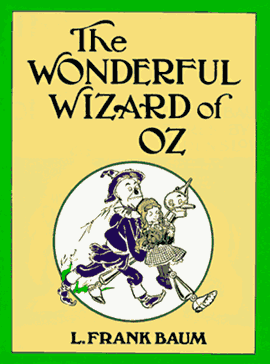
I was told after my last post that I should have shown you all my lovely little copy of The Wonderful Wizard of Oz. Unfortunately it was quite tricky to show the gold edged pages in a photo, but here is my little book anyway! I love the slightly camp cover illustration! 


Anyway, to this post's book, War Boy by Michael Foreman, a memoir of the author's wartime childhood. This is really beautiful book! The illustrations are wonderful, and the observations are funny and moving. I reminds me of Laurie Lee's classic Cider with Rosie, with it's village anecdotes, vibrant characters and naive charm. It's a favourite of mine, and well worth a read! 


War Boy begins with Michael remembering a bomb that came through the bedroom ceiling, 

I woke up when the bomb came through the roof.
It came through at an angle, overflew my bed by
inches, bounced up over my mother's bed, hit the 
mirror, dropped into the grate and exploded up
the chimney. It was an incendiary. A fire-bomb.


This introduction is poetic in both structure and style. It is a vivid image that you can see instantly in your mind's eye. You are catapulted straight into wartime Britain, and the rest of the story follows in the same way. Each page contains more illustration than text and this makes the story really engaging, as the words are not only written, but drawn and painted across the page. Foreman uses a mixture of single line drawings, wartime graphics, full page inky spreads, and delicate colour illustrations. Each page contains something different. The landscape orientation of the book gives the illustrations more room to tell the story, which is lovely! 


The story is full of lots of little anecdotes about life in wartime Suffolk. Having lived near there as a child I recognised the place names which was nice, it was all rather familiar! I particularly liked the stories about the corner shop that his mother owned. As a toddler he used to sit in the window like some kind of display, and eat the sweets out of their jars! The shop seemed to be the heart of the village, a place where the soldiers and sailors could go for a cup of tea, a cigarette and a chat! Again, Foreman has illustrated this beautifully, in particular the grumpy old lady trying to get to the counter for her shopping! 

This book is full of little gems, all illustrated in the most wonderful way. It is brilliant and touching story of life during the Second World War from a child's perspective, but it's also peppered with interesting facts about the troops and defences put in place on the Suffolk coast too. I'd thoroughly recommend Michael Foreman's War Boy to any child, or indeed anyone, wanting to learn a bit more about WW2.

Thanks for reading, L X

Next up is no. 95, Cornelia Funke's Inkheart. I've read the first few pages already and it's promising to be a really good read, so I'm quite excited! But... it's a huge book and I've got lots of stuff going on and another grown up book on the go too (Chocolat by Joanne Harris, I recommend it!), so I apologise in advance for the inevitably long wait for the next post! I may pop in a few other posts in the mean time about other things children's book related, so fear not!

Thursday, 3 March 2016

No.97 - The Wonderful Wizard of Oz


I opened the pages of my little gold edged copy of The Wonderful Wizard of Oz with hazy memories of the musical whirling around my head. Judy Garland skipping arm in arm with the Scarecrow, the Tin Man and the Lion down the yellow brick road, rainbow coloured horses and of course the ruby slippers. And I've been humming 'If I only had a brain' for weeks now!

I'll admit to not really looking forward to reading this book. There were bound to be books on the list that I just wasn't going to get on with and I was convinced that this would be one of those. Written in 1900, I was expecting the language to be dense and dry, full of moral teaching and sensible advice for children, like other books of this period. However, I was pleasantly surprised! It's actually beautifully written and Baum doesn't lecture his readers at all. The plot moves at a good pace, with Dorothy being blown away on the first few pages, which was much quicker than I had expected! I was expecting pages of waffle about her life in Kansas, but I was pleased to get straight into the adventure.

Like most fairy stories, the original has its fair share of gruesomeness and I'm pleased to report that The Wonderful Wizard of Oz is no exception! The Tin Woodman gives a lovely account of how he became a tin man by chopping off all his own limbs!! Given an enchanted axe by the Wicked
Witch of the East he then proceeds to accidentally cut off his arms, legs, head! Then to add insult to injury he manages to cut his own torso in half too! But luckily he gets each part sorted out by a tin smith and all is good! He is also not adverse to using his axe skills to save Dorothy and the others, chopping the heads off most of the enemies they come across! Another macabre touch are the pins that Oz puts in the Scarecrow's brain, which are supposed to show his sharp mind, but just protrude out of his scalp in a rather grim way when we he thinks too much! See the illustration below....


There are certainly a few things that are very different to the film. For example, there are no rainbow horses... they are all green. Also Dorothy's adventure was not a dream at all, but a real occurance! She arrives home find a new house has been built and that her aunt and uncle presume she has died! But far more shocking than that is that there are no famous ruby slippers in L. Frank Baum's book!! The shoes that Dorothy uses to get home to Kansas are in fact silver! They were changed to red in the film to show up in Technicolour! I guess silver slippers just weren't glamorous enough for Hollywood.

Thanks for reading X

Next up is Michael Foreman's War Boy, which I can't wait to write about! It was brilliant!


Saturday, 27 February 2016

Heroes and Villains

What do Matilda Wormwood and Paddington Bear have in common? Do they both enjoy a marmalade sandwich I hear you ask? No, though Paddington does always have one under his hat! Actually both characters appear in a list of favourite children's book heroes compiled from a poll taken recently by National Book Tokens.

There was also a list of favourites villains too, which was headed by the most evil of all, Lord Voldemort, unsurprisingly followed closely by the dreaded Professor Umbridge! Not all the villains were Harry Potter characters however, classic baddies such as Cruella De Vil were also featured.

As for heroes, Harry Potter characters still reigned supreme, with Harry topping the poll, and Hermione coming in 3rd. The list also featured the lovable characters Winnie the Pooh, a favourite of mine, and Bilbo Baggins too.

These were all good choices, and it made me think about who I would choose as my favourite heroes and villains of children's lit. So here are my top 5:

Heroes                                        

1. Burglar Bill (Burglar Bill, by Janet and Allen Alburg) for saving the baby, giving up his life of crime and becoming a baker!     
2. Bobby (The Railway Children by E.Nesbitt) for being so incredibly brave!
3. Harry Potter for being, well, Harry Potter I suppose!
4. Winnie-the-Pooh for being such a loyal and wonderful friend to Piglet.
5. Matilda for showing that knowledge is power! Plus she plays some pretty good tricks on horrible people too!


Villains

1. Mr Wormwood (Matilda by Roald Dahl) for being so ignorant of the joys of books and learning, and he's just plain nasty!
2. Bill Sikes (Oliver Twist by Dickens) because he's really scary!
3. Bellatrix le Strange for having no remorse at all! She's just plain evil!
4. The 'charming gentleman', or sly fox (The Tale of Jemima Puddle-Duck by Beatrix Potter) for persuading poor, simple Jemima to nest in his shed so he could plot to eat her!
5. Dawn (Sophie's Snail by Dick King Smith) for being a spoil brat and stamping on Sophie's beloved wood louse! Cruel!


I'm sure you can all think of lots more!
You'll find the full National Book Tokens list here.

Thanks for reading X

Monday, 8 February 2016

No.98 - Goosebumps


Call me a coward if you like, but I've never been into horror stories, or ghost stories either for that matter. Some people love them, find thrill in the fear, but I've never seen the pleasure in frightening myself! I just don't understand it! Maybe it's because I'm one of life's worriers, or because I have quite a vivid imagination and once something gets in there it tends to stick around. Needless to say I'd never read the Goosebumps book as a child. I know lots of people to whom these books were the staple of their childhood reading, but alas, not me. I remember looking at these books in the library when I was little and being put off by the slightly grim illustrations on the covers! So, as you can imagine I was a little wary of what these creepy looking books would contain, even at 24!

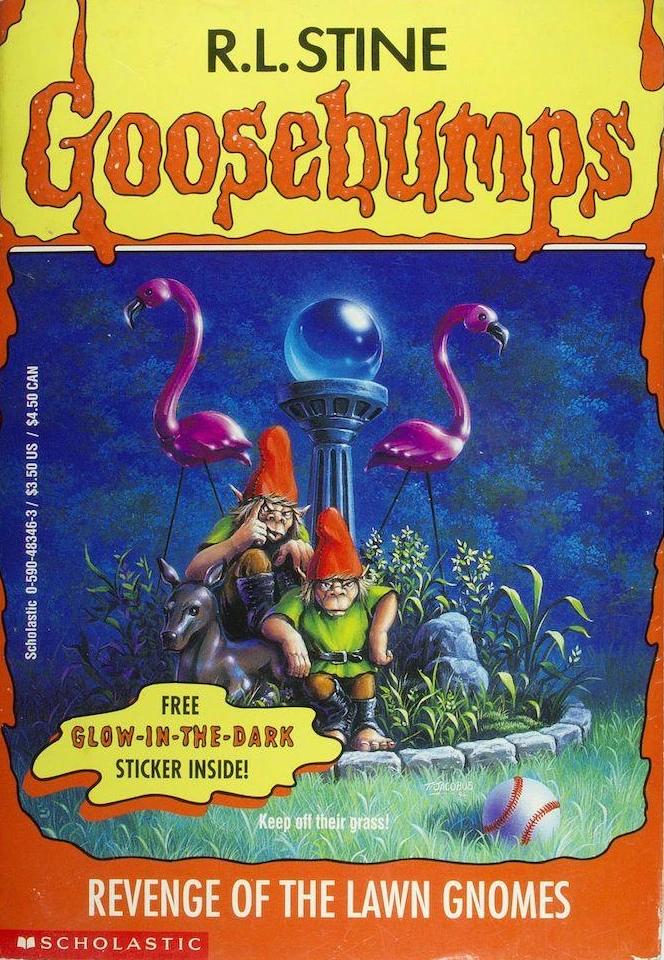
As the list didn't specify which book from the series I should read I went for the first one I could get hold of, Welcome to Dead House, a story about a family that moves into a creepy old mansion full of ghosts. As I've already said I don't have a stomach for ghost stories. Don't get me wrong I love watching Most Haunted for example and debunking the sightings and sounds, but in literary form I just don't like spooky or morbid things. It's just a children's book I hear you say, and I know I must sound like a total wimp, but I just couldn't get on with Welcome to Dead House, with its ghost children and dreams of dying. With this in mind I headed out to Trelissick Gardens, our local National Trust, to see if they had any other Goosebumps titles in their second hand bookshop. Luckily they had plenty of them to choose from! Children seem to devour these books one at a time but never read them again, as they often pop up in these kinds of places. Despite being tempted by a story about a murderous piano teacher, I opted for the rather amusingly titled Revenge of the Garden Gnomes! Much better, less death and more fantasy.

As with Welcome to Dead House, I was initially annoyed by the Americanised writing style, predictable story line and short staccato sentences. But then I remember that it was a children's book and not a work of classic adult literature! I guess these stories are aimed at the 6-10 age bracket, depending on their content, and the short chapters, fast paced story, lots of dialogue, and easy to grasp characters would make them a satisfying read for most children. I expect it would be quite easy, once you got the taste for them, to read them all, one after another. Although these type of books were never my cup of tea i'm still glad they exist, because a series like Goosebumps could be the catalyst that gets a child reading, which is invaluable!

Ok, to the story. The Revenge of the Garden Gnomes follows the strange goings on in a family's garden after the dad brings home two slightly creepy looking garden gnomes. The next door neighbour and the dad are both growing produce for a local fruit and veg competition, and the cheeky gnomes cause all kinds of fruit based mischief, coming alive at night and squashing things, eating stuff and even drawing faces on the melons! For a while Joe, the son, tries to convince his parents that the gnomes keep coming alive at night and causing all this trouble, but instead he and his dog Buster get the blame! This goes on for a while, with something different happening every night. In the end Joe and his friend Moose (?) stake out the gnomes and catch them in the act! Unfortunately they get spotted and the gnomes come after them, kidnapping Joe's sister Mindy in the process. Once they've got the children's attention they spin a rather hammy yarn about having been taken from their natural forest habitat and forced to be garden ornaments by the sweet old lady that owns the garden ornaments shop! The gnomes ask the children to accompany them to Lawn Lovely (again, ?) the garden ornaments shop, to free the other 6 gnomes that are in the basement. Now, this is clearly a trap, but as we know from Tintin, story characters seem to be very gullible! So the children go with the gnomes and get trapped in the basement of the shop with hundreds of evil garden gnomes!! Not cool! The dog Buster becomes their only hope of escape, as Joe believes the gnomes are scared of him. This hope is short lived however, when Buster abandons them, not liking the smell of the basement, which as Stine graphically explains, stinks of gnome sweat!! Anyway, the children finally discover that it's Buster's dog whistle that the gnomes are scared of and not the dog himself. It turns out that the whistle transforms the gnomes to stone, which conveniently allows the children to escape! Hooray! When they return home they discover that their dad has bought a new garden ornament, to replace the gnomes he believes have been stolen. As Joe looks at the new garden gorilla it winks at him! Could it all be happening again......

This was a truly bizarre story and I commend R.L Stine on his ability to come up with these strange story lines, especially as there are 62 Goosebumps books!

Thanks for reading,  L x

Next up The Wizard of Oz by L. Frank Baum.

Sunday, 31 January 2016

No.99 - Swallows and Amazons


When I first voiced the idea for this blog it was agreed that if I had already read any books on the list I had to read them again or I wouldn't be doing it properly. That said I realised that I was going to have to re-read Swallows and Amazons even though I had only read it last year! It was one of the set books on the Children's Literature module of my degree, and I'll admit to having rushed the reading the first time around to get it read in time for writing an essay. This time, despite my reluctance to re-read this classic tale it wasn't actually that bad! 

Originally published in 1930, this children's adventure tale is very much of its time. It is littered with phrases such as 'Hallo!' and 'I say!', and the Walker family are very clearly middle class. It's an example of the popular interwar genre of the holiday adventure story, a genre that provided an idyllic and rather romanticised view of childhood; an escape. The story is set in the Lake District and follows the adventures of the Walker children on their summer holiday. John, Susan, Titty (no sniggering please...) and Roger take their little sailing boat Swallow out across the lake to a small uninhabited island where they set up camp and stay for a while. This is all well and good but their mother seems totally unperturbed by the fact that her children, whose ages range from probably around 12 to 7 are completely alone on a small island fending for themselves night and day! Despite this the children actually cope very well on the island, relishing the time spent away from the 'natives' on the main land. Here they meet a band of pirates, the Amazons, and together have jolly adventures on the high seas! 

Swallows and Amazons has rather a quaint story line and a nice assortment of characters, some very loveable and some rather stereotypical. My favourite character by far is little Roger, the youngest and the ship's boy. The book begins with him pretending to be a sailing boat, tacking up the hill to the farmhouse, totally committed to being a ship and loving it! From this point onwards I had quite the soft spot for him and his outlook on life. Titty, which I think is short for Letitia, has a wonderfully romanticised view of their adventure, pretending a lot of the time that she is in an adventure novel of her own. When left alone on the island she pretends she is Robinson Crusoe and when mother visits she christens her Man Friday. Defoe's classic is referred to quite often in the story, along with Stephenson's Treasure Island (coincidently that's no.50 on the list). As you can see the two youngest Walkers are quite individual, the problem, I feel, arises when we consider Susan and John. Susan, although cast as the ship's mate in the adventure, unfortunately falls foul to all the domestic tasks, doing all the cooking, cleaning, sewing, and mothering whilst they are on the island.  She is absolutely the mother figure, telling the crew when to go to bed, to keep warm and worrying about what she is going to feed them everyday. I felt quite sorry for Susan, but then this portrayal of girls was not unusual in those days. Parents liked their children read books that had characters that would be good role models for them, and I think this is the case with the characters of Susan and John. He is the father to Susan's mother, concerned totally with the fate of his boat and his crew, and constantly trying to live up his father's role as a navy man. Despite having read this book twice now I am still in the dark as to which way is port and which is starboard, and I have no idea what a boom or a painter is. And Ransome makes that no clearer! If you, like me, have no idea about sailing terminology then you will be lost by the huge amount of references included in this book. As a child I think this would have really put me off, as its really quite technical. However, if you can get past that then the story really gallops along.

About a quarter of the way into the book we meet the Amazon pirates, Nancy and Peggy Blackett. They are around the same age as the Swallows and live just up the river from the lake. They too have a little sailing boat, named Amazon. Nancy's real name is Ruth, but as Ransom tells us pirates are supposed to be Ruth-less, so of course she had to change her name! They makes friends but also agree to have a war; of course, why wouldn't you! This entails a longwinded but rather exciting adventure in the dark, in which Amazon is captured by the cast away Titty and everyone stays up all night! After this there is another war with a retired pirate who lives on a houseboat, a case of burglary, hidden treasure, a huge and rather devastating storm, shark steaks for tea, a gift of a real parrot, and the threat of a monkey too!

The story is really rather fun, but what makes this book even more charming are the illustrations. Drawn by Ransome himself, because he didn't think anyone else would do a good enough job, these simple little line drawings capture a real sense of the story. Below is a lovely drawing of Titty and Roger having a swim!


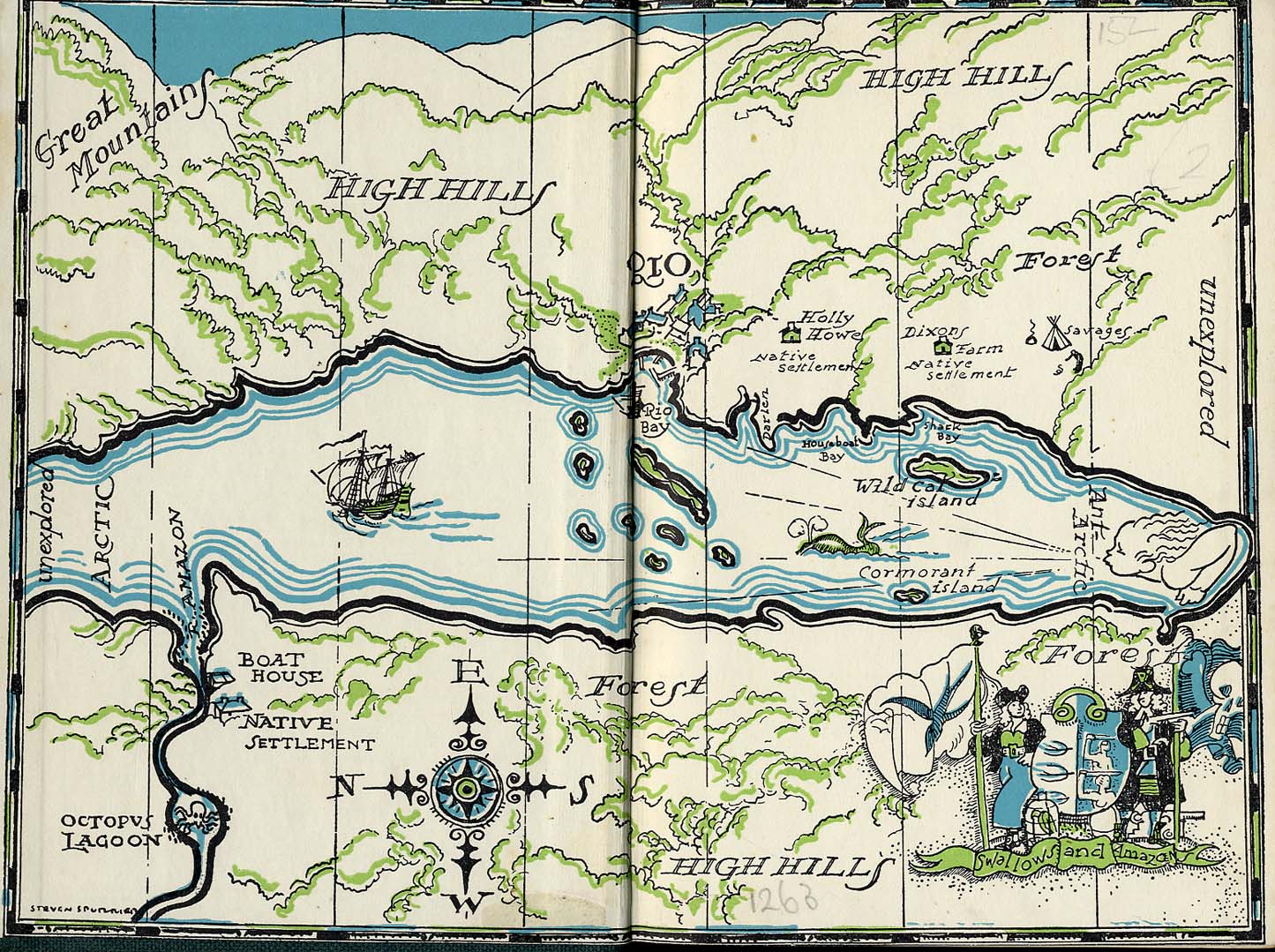
Also there is a fantastic map in the front of the book, which everyone knows is the sign of a good book! It shows the lake and the islands, all of which were named by the children. In the story the map is drawn up by John as the ship's chart, complete with giant whale, a pirate ship, wind-blowing lady, settlements and unexplored territory. It's certainly the stuff of pirate stories!


All in all, I enjoyed my re-reading of Swallows and Amazons. It's a classic and should be read by everyone at some point in their lives, especially if you enjoy an adventure!

Thanks for reading, L x

Next up is a Goosebumps book!