Monday, 12 February 2018

No. 75 - Ballet Shoes

So, here we are, officially at no.75, a quarter of the way through this journey! I've been pretty motivated since January to read and write more, so hopefully I can keep this pace up and read and share lots of fab books this year! 
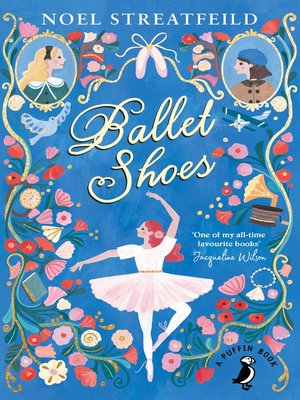


Today I want to talk to you about Noel Streatfeild's classic story Ballet Shoes, published in 1936. Last year I watched the most lovely adaptation of the story on the tele, starring Emma Watson, Emelia Fox and Victoria Wood, amongst others. The film was beautiful, and the story enchanting, with the screenplay written by Heidi Thomas, who writes Call the Midwife, and recently adapted Little Women for the BBC. So having enjoyed this so much, I was excited to read Ballet Shoes. For those of you who don't know the story it is all about the Fossil sisters, Pauline, Petrova and Posy. They are each found and adopted as babies by the eccentric explorer and fossil collector Gum, who sends them back to England to live with his niece and her nanny in London. It soon becomes apparent that Gum is not coming home for a very long time, even presumed missing at one point, and so Sylvia and Nana are left to bring up the three girls themselves. Money is tight and it is suggested that the girls get training in something that will help them make a living when they are older, so they start attending The Children's Academy of Dancing and Acting. Streatfeild, who trained at RADA, knew a thing or two about the theatre, and it is very apparent that she is comfortable writing about this world.

The plot is slightly different to the adaptation I was familiar with, but the characters were certainly the same. Nana is fussy and a stickler for sensibleness, routine and order in her Nurseries. Sylvia, known to the girls as Garnie, a portmanteau of Guardian and Auntie, is a timid, sad lady, who only wants the best for her girls, and despairs when she cannot provide for them. Pauline, the eldest of the Fossil sisters was found at sea after a shipwreck. She takes to acting and loves to perform, in particular recitation. Her talent takes her far, though causes problems at times, especially when she lets it go to her head! Petrova, found in Russia, therefore given a Russian name, is not at all interested in being on the stage. She would much rather fiddle with engines and fly aeroplanes. However, she grits her teeth and gets through performance after performance, so that she can give Garnie some money towards their upkeep. The littlest Fossil, Posy, was abandoned by her dancer mother with a pair of ballet shoes, so is destined to be a ballerina. She is such a good dancer in fact, that she gets private lessons from the Russian ballerina who owns the Academy. She is almost heartless in her absolute need to be the very best, which as it turns out is not a bad thing! Alongside the girl's and their wards, there are some other lovely characters, my favourite being the two lady doctors who take lodgings in Gum's big house. They are not medical doctors, but doctors of literature and mathematics, and so take it upon themselves to educate the girls. There is also the rather glamorous Theo Dane, another boarder, who teaches ballet at the Academy. And finally, lodging with Sylvia and the Fossil's are Mr and Mrs Simpson. In the tele adaptation there was no Mrs Simpson, and Mr Simpson acted as the love interest/father figure. I was quite glad to see that this was not the case in the book. The plot is purely centred around the girls and nothing else.

Cleverly, Streatfeild has written some wonderfully strong female characters in this book. Rather like Louisa May Alcott in Little Women, she has managed to create a tight knit female family unit, each with their own strengths and weaknesses. The only male characters that exist are those in the theatre industry, or at the Council, and of course Mr Simpson and Gum. However, Mr Simpson has quite a stereotypical male role, helping the girls out financially, and teaching Petrova all about cars and planes. And Gum of course is pretty much non-existent for the entire story! In fact he is talked about with distaste by Nana, and considered a bit of a let down! By the end of the book Streatfeild has created three thoroughly independent young ladies, all pursuing their own dreams and their own interests, even Petrova, who ventures where many women at that time had not. The book ends with the question "I wonder... If other girls had to be one of us, which one of us they'd choose to be?" And what a choice for the girl reader; ballerina, actress, or pilot. I know which one i'd choose!

Throughout the book the Fossil sisters vow to get their names in the history books, and not because of something their Grandfathers did, but because of what they achieved themselves. I would say that this is a very appropriate sentiment at the moment, what with the trend in books that aim to encourage girl's to follow their dreams, and empower them with stories of women who have. Streatfeild's girls could quite easily be added to the biographies in these books, as women who raised themselves up from nothing, not even knowing their own parentage, and followed their dreams.

Thanks for reading, L x

Next up, The Velevteen Rabbit

Saturday, 3 February 2018

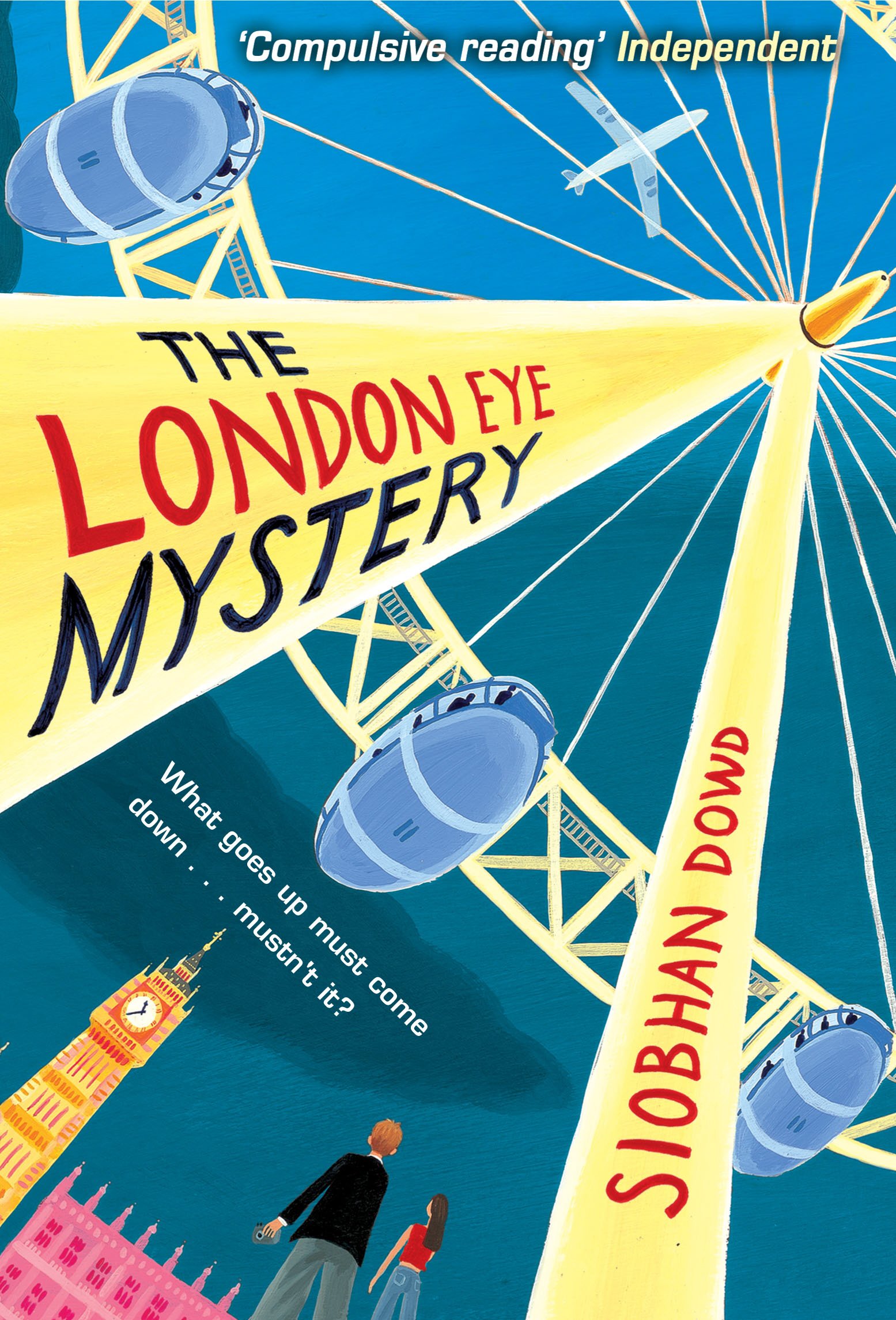
No. 76 - The London Eye Mystery

Hi there, me again! Another book review for you! The first official one of 2018 in fact! This time i'm taking a look at The London Eye Mystery by Siobhan Dowd.


Prior to this project I had ashamedly never heard of Siobhan Dowd, and it wasn't until I did a little research for this post that I discovered Patrick Ness's A Monster Calls was in fact Dowd's story, and he wrote it for her after her death. That was a lovely little factoid, plus I also found out that Robin Stevens (of Murder Most Unladylike fame) has written the sequel to The London Eye Mystery, The Guggenheim Mystery, based on Dowd's original ideas too. So there's lots of literary love going on there! Hurrah!

Obviously being a mystery story I can't, and won't, give away too much! Our narrator, Ted, has Asperger's. He struggles with reading body language and social interactions, but knows everything there is to know about meteorology. He dreams of becoming a meteorologist, and the book is littered with weather facts and references, which are a really interesting aside to main the story. That's also how Ted's disability is treated, as an aside. It is never named, sometimes called Ted's syndrome, or as Ted puts it, his brain just runs on a different operating system to everyone else's. Personally I can't decide on whether not naming Ted's Asperger's is a bad thing or not? He often makes references to the way he deals with situations using tools he has been given by a teacher, especially when recognising emotions in others. He also has physical reactions to stressful situations, which are pointed out all the way through the book. But these things this are never attributed to his Asperger's, just noted, and we recognise him as being different, but not necessarily in a bad way. Ted uses his different operating system to solve the mystery in a way no one else could, just like Christopher Boone, in The Curious Incident of the Dog in the Nightime. Books like these highlight the value of thinking slightly differently and hopefully encouraging child readers on the Autistic spectrum to value their differences and not see them as a disability. It may also help children understand more about Autism if they come across it in others. So maybe, by not specifically pointing out that Ted has Asperger's, Dowd has very cleverly made the subject so much more accessible.

When Ted's Aunt Gloria and cousin Salim come to stay there is one thing, as a tourist to London, that Salim wants to do. He wants to ride the London Eye! Ted and his sister Kat have been up before and both agree that it's an amazing experience, Ted explaining about the wheel's engineering, and Kat excitedly telling Salim about the views. It's agreed and the three of them set out for the Eye the next day. Whilst queuing to buy their tickets a stranger offers them his, saying that he's changed his mind and didn't fancy it, claiming to be claustrophobic. As there is just one ticket, and Ted and Kat have been up before, they let Salim board the pod in place of the strange man. Ted notes the time, 11.32, knowing that Salim will be back done in precisely 30 minutes. Just as Ted predicts at 12.02 Salim's pod touches down, the doors open, but Salim is nowhere to be seen.....

That's all i'm going to say, so you'll have to read it if you want to know what happens next! Has Salim vanished into thin air? Was he hiding under the seat in the pod hoping to go round again? Had Ted got the time wrong? Or did he spontaneously combust? Ted must consider all these potential scenarios and more! With the help of his sister Kat, can he solve the London Eye Mystery and bring Salim home?

Thanks for reading, L x

Next up, Ballet Shoes by Noel Streatfield.


Monday, 22 January 2018

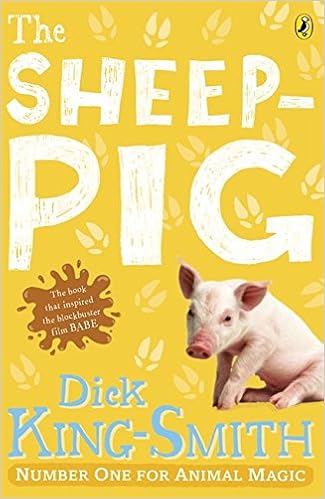
No.77 - The Sheep Pig

This is my last catch up post from 2017, after this we can get on with all the books 2018 has to offer!

I am aiming to read more books from the list than last year, 15 is my 2018 target! I'm looking forward to Ballet Shoes by Noel Streatfield, as the TV adaptation starring Emma Watson is just lovely! And one of my all time favourite books is coming up too, The Worst Witch by Jill Murphy! Alongside those beauties are offerings from Oliver Jeffers, Michael Rosen, J.M Barrie, and Anne Fine to look forward to. For now though, here are my thoughts on one of the loveliest books i've ever read!

I'm sure everyone has seen the film 'Babe', and even it's ridiculous sequel 'Babe: Pig in the City', so you'll all familiar with the little pig, raised by a sheep dog, who has affinity with sheep. Well let me tell you this, the film is lovely, but the book is even more wonderful!


Babe, so called because that's what his mother called him, is such a cutie! Won by Farmer Hogget in a 'guess the pig's weight' competition, he is taken home and adopted by loving sheep dog mummy Fly. Fly and her pups raise Babe as one of their own and soon Babe is convinced his raison d'etre is to heard sheep just like them!

This book oozes charm. Dick King-Smith knew how to write about animals, and about the unconditional love that exists between man and beast. In The Sheep Pig the most moving character development is most certainly the bond that builds between Farmer Hogget and Babe. To start with there is talk of eating the pig, which would have been the most obvious thing to do, yet the farmer can't quite bring himself to agree with his wife. As Babe becomes more and more 'dog-like' Farmer Hogget becomes quite fond of him, until eventually they have formed a bond as strong as a man and his dog. Farmer Hogget sees that Babe is more than just a pig, he is special.

Flowing through this book there is a strong message about believing and trusting in others. Fly and Farmer Hogget believe in Babe, and encourage him to become a sheep-pig. At no point is he told that he shouldn't. This is an important message that can be transferred into so many different situations. Just because he is a pig, doesn't mean he can't do a dog's job, especially if he is good at it. Take that sentence and replace it with sexist or racist connotations and you've got a life message for children everywhere; you can be whatever you want to be, and don't let anyone tell you otherwise!

Reading this book was an unexpected revelation. I knew the story, but I wasn't at all prepared for the emotional impact it would have on me. By the end I was almost in tears! There are certainly ups and downs in this book, high points and low points, but in just 135 pages this book says more than you could ever imagine when looking at the cover.

Thanks for reading, L x

Sunday, 14 January 2018

No.78 - Chrestomanci - Charmed Life

It seems an awfully long time since I sat down to do this, and to be honest, it has been! My last proper post was in August!! Anyway, I have welcomed in the New Year and The Little Bookworm's 2nd birthday, and have a few loose blog ends to tie.

I have two books hanging over from 2017 that are yet to be reviewed, mainly because I squeezed reading them into the last few weeks of the year, and then Christmas came along.

So, first up, at number 78 on the list, is the 'Chrestomanci' series by the British fantasy and sci-fi queen Diana Wynne Jones. For those of you who have never heard of her, she wrote Howl's Moving Castle, on which the very famous Studio Ghibli film is based (albeit loosely). Anyway, the list called for 'Chrestomanci: The Lives of Christopher Chant', but as I couldn't get hold of that one, I read the first book in the Chrestomanci series 'Charmed Life'.


Who's the dapper chap on the cover I hear you ask? Well that would be Chrestomanci himself, extremely powerful enchanter, ruler of his very own magical kingdom, and owner of a glorious amount of flamboyant dressing gowns! But the story's not really about him. Instead, the story follows the lives of orphaned brother and sister Cat and Gwendolen Chant. Cat and Gwendolyn are very different. Cat, or Eric as he is really called, is a timid boy with low expectations of his magical powers, always eclipsed by his bossy, and rather vile, sister Gwendolen. She appears to have all the magical talent in the family. However, when she starts taking extra magic lessons from a slightly dodgy wizard their lives take an interesting turn. 

Published in 1977, this book sits among some of the classics of children's fantasy literature, in particular the magical school genre, which was popular at the time, and that J.K Rowling so wonderfully revisited in the Harry Potter series. In my opinion, if done well this genre never gets old! For children it allows a level of escapism, through an already very familiar setting of school. Unlike something like Ursula Le Guin's 'A Wizard of Earthsea' however, the story is set in a domestic setting rather than a boarding school. However, the school room and the things the children get up to still very much sit within that genre. 

Cat and Gwendolen are sent to live at Chrestomanci Castle, with the great enchanter and his family. Gwendolen is convinced that the move is down to her amazing talents, and that she will be rich and spoilt forever, but that is not quite the case. I might not have anything to do with her at all.... 

When no one takes any notice of her magical abilities Gwendolen begins to wages war on Chrestomanci Castle and it's inhabitants. Determined to show the powerful enchanter what she can do she begins using her magic in dangerous and selfish ways, causing all kinds of nasty spectacles and horrid apparitions. As ever, cool and calm Chrestomanci ignores everything she does, no matter how vile, so Gwendolen decided she's had enough and disappears into a parallel world. However, she doesn't go without leaving something for Cat, a replacement sister! Enter poor old Janet, a non-magical (we could call her a muggle) girl from another parallel world. She is identical to Gwendolyn in looks but luckily not in temperament. She is a kind girl, who is totally confused by the whole thing, and frankly slightly annoyed that she's been dragged from her nice cosy life into Cat's world. 

As you probably know by now, I hate a plot line where the children don't tell the adults what's gone wrong. Honesty is the best policy I was always told, but it clearly doesn't spin a good yarn! 
Cat and Janet don't tell anyone that Janet is not Gwendolen! But what a mess the real Gwendolen has left for them to clear up! There is the issue of Cat's life for starters, but I won't spoil that for you as it's a nice twist. And then there is the very angry boyfriend of the maid who challenges Cat to a magical duel for something that Gwendolen did! Plus the whole story climaxes in a massive magical mutiny! I shan't give you all the details, but hopefully these events, plus a whole range of slightly bizarre, and even villainous characters, will entice you dip your toe into the World of Chrestomanci. 

Thanks for reading, L x

Next up another catch up post about Dick King Smith's classic story 'The Sheep Pig'

Monday, 1 January 2018

Happy 2nd Birthday Little Bookworm!

Can you believe it, The Little Bookworm Blog is 2! Hooray!


In 2017 I slowed down slightly on the reading front due to other commitments, but i'm still well and truly committed to this project, and can't wait to get back on it this year. 2017 saw me read 11 books from the list (2 of which i've not yet reviewed so watch this space!), and in total I am nearly a quarter of the way through! I know that doesn't sound like much, but out of 100 I don't think that's too bad!

It's been really hard to pick a favourite from the 9 i've read and reviewed, so here are my top 3, along with the reviews for you read again.

1. Carrie's War by Nina Bawden, because of it's slightly Dickensian nature, and its touching themes.
2. Emil and the Detectives by Erich Kastner, because it was full of childhood fun, intrigue and excitement, despite appearing boring to begin with.
3. The Wolves of Willoughby Chase by Joan Aiken, because frankly it was downright bizarre at times!

I've got to catch up with the reviews for 'Chresomanci: A Charmed Life' by Dianna Wynne Jones, and 'The Sheep Pig' by Dick King Smith, but i'm off to work on them now, so it wont be long.

This is just a short post, but I had to mark the blog's 2nd birthday somehow! Oh, and Happy New Year!

Thanks for reading, L x


Tuesday, 15 August 2017

No.79 - The Little Prince

We've officially hit the 70s, hurrah! And what better book to start than with Antoine de Saint-Exupery's classic Le Petit Prince, or The Little Prince. 


I would certainly call reading this book an experience, and to be honest i'm not sure if it's a good one or a bad one. I've literally just put this book down, and my over-riding emotions right now are that of bafflement, confusion and possibly a little sadness! What a bizarre book! Within the first few pages it had me thinking of the twentieth century Modernist texts that I had studied during my degree, with their symbolism and philosophical approach to, and examination of, modern life. It seemed a very grown-up book, yet it seem to deride grown-ups and their outlook on the world, in a way that Peter Pan or Roald Dahl might be proud of! I was thoroughly confused. In front of me was a book that I had initially associated with adult literature, yet it spoke to me in the voice of children's fiction....


This is the way the book begins,

But look again, it is in fact not a hat, but a boa constrictor eating an elephant, from the outside. This surreal image really appealed to me, and I began warming to my narrator! Especially when I was then presented with this, 

A boa constrictor eating an elephant, from the inside! As amusing as this was, it was all making an important point; grown-ups forget how to use their imagination, and have to have all the obvious things explained to them! Very Roald Dahl don't you think! 

The story, in which a pilot stranded in the Sahara Desert meets a Little Prince from outer space, is punctuated with philosophical and moral moments such as these. On the official Little Prince website I am told that it is a story of a grown-up meeting his inner child, and this makes a lot of sense, but also no sense at all, a recurring theme in most of the book! I tried so hard to understand the deeper elements of this book, yet struggled to understand quite what the point was. It seemed to be stuffed full of comments on humanity, responsibility, vice, greed, selfishness, ignorance, the perils of growing up, the plight of the grown-up, love, grief, friendship, childhood, and happiness. These can be seen as The Little Prince journeys across space visiting various planets, each home to another personified vice of man. 

If we are to believe the idea of an adult meeting with the inner child then the ending seems to make sense. The Little Prince must leave, and like in all good children's books that deal with magic, be it Mary Poppins or Peter Pan, this way of looking at the world must be given up, isolated within childhood and never cross over into adulthood, a time of responsibility and sense. However, the narrator does ask us to keep a look out for the return of The Little Prince, just in case he can relive a glimmer of this childlike outlook on life. There is an element of sadness here, as if he, as an adult, longs for a life that is much simpler and happier. However, you could also say that the Prince was in fact a hallucination of a desperate man, stranded in the desert, slowly loosing consciousness. It's hard to tell. So many questions and things to make you think, and all squished into just around 90 pages!

I had heard of this book prior to reading it, and had been told it was a classic of children's literature loved by children and adults alike. But this was all I knew. I had no idea what is was about, or what made it so special. I'm afraid to say, i'm still a little in the dark. However, here are a few things that I do know about The Little Prince, 
  • 150 million copies of the book have been sold worldwide.
  • There have been 300 translations.
  • 400 million people and counting have read it!
  • There's a film, i've seen the trailer and it looks quite good! 
  • There was a The Little Prince TV series, which was shown in 50 countries. 
  • There's a The Little Prince musical.
  • There was a 4D ride shown in theme parks across the world!
  • There is a Le Petit Prince shop in Paris full to the brim with official merchandise!
  • There is a charity foundation.
  • In France you can go to The Little Prince theme park.
  • In Japan you can visit The Little Prince Museum.
  • In Korea you can go to The Little Prince Village.
  • This year an astronaut took a figurine of The Little Prince to the International Space Station!!
So clearly, there is something rather special about this book, and it's name sake! It is quaint, and the image of The Little Prince alone on his asteroid, barely bigger than him, with his 3 volcanos, his rose and his baobab shoots, is one not easily forgotten, yet I do wonder what the rest of it is for.... Maybe there's a secret meaning that i'm yet to discover. I will probably read this book again just to make sure i'm not missing anything. 

The Little Prince was one of Antoine de Saint-Exupery's last books. In 1944, just 2 years after it's publication, he died when his plane was shot down whilst on a mission for the Free French Forces. I likened Saint-Exupery to Roald Dahl at the start of this post, and it strikes me as a fitting comparison. Here are two men, both airforce pilots during the second world war, seeing things that were no doubt truly horrific, and being asked to defend their countries and risk their lives no matter what was thrown at them. It's not surprising really that they lost their faith in the adult world is it?

Thanks for reading, L x


Next up a look at Charmed Life by Diana Wynne Jones, the first book in her Chrestomanci series. 


*All the information about The Little Prince phenomenon and the author's life was found here and here.

Monday, 7 August 2017

Going 'Into the Forest'

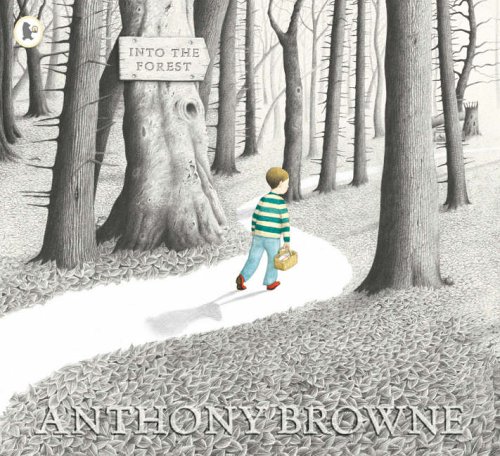
This is Anthony Browne's picture book Into the Forest.


I came across this book whilst doing some research for an essay, and I was instantly intrigued by its illustrations. I starts in colour, and then as the boy enters the forest his world desaturates and we are left to navigate a monotone tangle of spiky trees and hidden fairy tale references. The obvious fairytale link in this story is Little Red Riding Hood, but there are also references to Jack and the Beanstalk, and Hansel and Gretel too, amongst others. I looked at this book quite a bit during my research, but since then hadn't really given it a second thought, until this week.

My Dad had just purchased a bit of woodland and I'd gone up to visit him and take a look! In my head this woodland was deciduous, a green and mossy landscape, friendly and inviting. Instead, this woodland was pine, thick, dense and dark. I stood in the absolute silence, looking at the monumental trees around me, and found myself transported to the pages of Anthony Browne's book.


The likeness was incredible! Well, to me anyway! The short pointy branches jutting out of each trunk, the desaturated colours, the paths cut through the trees; I felt like I was standing in a fairytale.


I kept expecting to look around and see the leg of a giant rather than a tree-trunk, a little figure scuttling off into hiding, or a set of eyes watching me. Anthony Browne is amazing at hiding little things like these in his images, quirks that you never see the first time you look, but make you smile the second. I was half expecting to see magical things in these photos!


It just goes to show that books play a huge part in the way we perceive the world. Have you ever found yourself somewhere you feel you know, only to realise that's because you've read it? Or imagined a place in a book as somewhere you already know? The wonderful thing about reading is that our memories keep little snippets of the information we've read, imagined or seen, hidden away ready to inform our experiences when we least expect it. Having stood in Anthony Browne's forest I can testify that that is a magical thing! 

Thanks for reading, L x